Best Webflow Templates for Healthcare and Medtech Companies in 2026

In healthcare, the website is not just a marketing asset. It is the first clinical impression. And in a sector built entirely on trust, that impression either earns the appointment or hands it to someone else. According to rater8's 2025 patient survey of 1,008 U.S. adults, 84% of patients check online reviews before choosing a new provider — and 61% now prioritise those reviews over personal referrals from friends and family. A well-structured, credible website is the foundation that makes those reviews land.
The market is also moving fast. By mid-2025, 26% of patients said AI tools — ChatGPT, AI-generated review summaries, voice assistants — had directly influenced their provider choice, putting AI on par with primary care referrals (28%) and healthcare review sites (29%) (rater8, 2025). One-third of patients now trust AI-generated search results as much as Google, and nearly one in five trust AI more (TechTarget, 2026). On the medtech side, digital health startups raised $4 billion in Q1 2026 — the strongest first quarter since the pandemic peak — with 12 megadeals capturing 59% of total funding (Rock Health, 2026). The market is concentrating around AI-enabled platforms with credible scientific positioning, which raises the bar for medtech and biotech websites in the same way concentration has raised the bar for VC firm sites.
This guide covers the best Webflow templates for healthcare providers, medtech companies, biotech startups, and research organisations in 2026. Each template is reviewed on what actually matters for this audience: patient trust signals, clinical credibility, appointment booking compatibility, and whether the structural depth matches the complexity of healthcare content.
Not sure which template category fits your organisation? Take the Loonis Launch Plan Builder quiz for a recommendation in under 3 minutes. Or read the full guide to choosing a Webflow template first.
What do healthcare and medtech websites actually need?
Healthcare websites require a specific information architecture that generic templates cannot provide: clinician credentials prominently displayed, individual specialty or condition pages, appointment booking integration (not a contact form), patient information content, mobile-first layout, compliance pages, and — for medtech and biotech — product, pipeline, and partnership pages. Each of these is a structural requirement, not an aesthetic preference. A template that doesn't include them forces you to build them from scratch.
Healthcare websites carry a higher trust burden than almost any other category. The visitor may be anxious, in pain, or making a significant decision about their health or their organisation. Generic templates designed for agencies or SaaS products consistently fail this audience — not because they look bad, but because their information hierarchy is built around conversion, not trust.
From our experience building Sanaris and Scientis across the healthcare vertical at Loonis, the trust signals that move the needle are structural: credential placement, specialty page depth, and patient information architecture. These cannot be retrofitted into a generic template without significant custom development.
Here is what a well-structured healthcare or medtech website requires:
- Clinician credentials front and centre. Not buried in an about page. Doctor names, qualifications, and specialisations should appear on the homepage and service pages. This is the single highest-impact trust signal in patient-facing healthcare.
- Individual specialty or condition pages. Patients search for specific treatments and conditions. A single "services" page with a bulleted list loses all of this search traffic. Each specialty needs its own CMS-powered page.
- Appointment booking integration — not a contact form. Patients who cannot book online in under two minutes will call a competitor. Webflow connects to scheduling tools via embed; the compliant system handles the data.
- Telehealth as a first-class service line. In primary care, behavioural health, dermatology, and endocrinology, 30% to 60% of new patient volume now books their first visit as a telehealth appointment (210 Digital Marketing, 2026). Treat virtual care as its own landing page and booking flow — not as a footnote on the contact page.
- Patient information and what-to-expect content. Explaining your process, what patients should bring, and what a first visit looks like reduces pre-visit anxiety and improves appointment completion rates.
- Mobile-first layout. A significant portion of healthcare searches happen on mobile — often by people in pain, in waiting rooms, or pressed for time. A template that does not work cleanly on mobile fails at the exact moment it matters most.
- Privacy and compliance pages. These are not legal footnotes — they are trust signals. Healthcare audiences read them. Proper page structures for privacy, terms, and accessibility signal organisational maturity.
- For medtech and biotech: product, pipeline, and partnership pages. B2B healthcare buyers need technical depth — platform architecture, regulatory status, clinical evidence. Consumer-facing healthcare templates are structurally inadequate for this audience.
Is Webflow HIPAA compliant for healthcare websites?
Webflow is not HIPAA compliant for storing or transmitting protected health information (PHI), and Webflow does not offer Business Associate Agreements (BAAs) — but most healthcare marketing websites do not need to handle PHI at all. A marketing website that showcases services, publishes content, and embeds a booking widget from a compliant third-party system operates outside HIPAA's scope entirely. The compliant tool handles patient data; Webflow hosts the public-facing layer.
Patient appointments, intake forms, clinical notes, and insurance information should live in HIPAA-compliant third-party platforms: Jane App, Calendly Health, Practice Fusion, or your existing practice management system. Each of these can sign a BAA with your organisation. Webflow connects to these via embed — no PHI passes through Webflow's infrastructure, and the BAA chain stays inside the compliant tools.
Where this becomes a genuine concern is if patient health data passes through Webflow forms directly. Do not configure it this way. Keep Webflow strictly as your public-facing marketing layer and route all clinical data collection through purpose-built compliant tools that can sign BAAs.
Important caveat: HIPAA requirements vary significantly by organisation type, jurisdiction, data handled, and how third-party integrations are configured. The guidance above reflects general principles — not legal advice. Verify your specific setup with your compliance team or legal counsel before launching a healthcare site on any platform.
Which Webflow templates are best for healthcare and medtech in 2026?
The two strongest Webflow templates for healthcare and medtech in 2026 are Sanaris (best for patient-facing providers and consumer-facing medtech) and Scientis (best for biotech startups, research labs, and science-driven B2B organisations). Both are $169, include 21-22 pages, and come with Figma source files. The decision between them is architectural — not aesthetic.
1. Sanaris — Best for healthcare providers and patient-facing medtech
Price: $169 | Pages: 21 | Style: Light, Modern
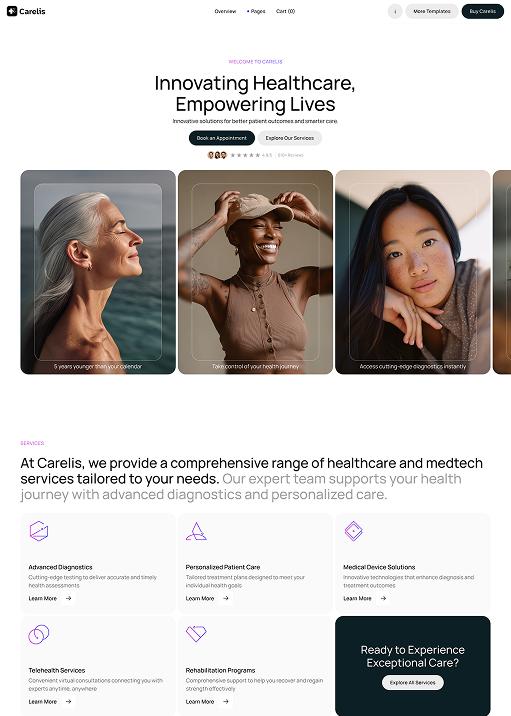
Sanaris is designed around a specific understanding of how patients evaluate healthcare providers online. The layout is calm, precise, and structured to answer the three questions an anxious visitor asks first: who you are, what you treat, and how to reach you.
The 21-page structure covers the full requirements of a professional healthcare or medtech site: a homepage built around credibility signals, individual service or specialty pages, a team section with space for clinician credentials and photography, patient information pages that reduce pre-visit anxiety, a blog for health education content, testimonials placed where decisions are made, and a contact page with appointment booking integration points.
What separates Sanaris from generic healthcare templates is the patient journey thinking in the layout. The information hierarchy guides an anxious visitor toward confidence and action — not toward a feature list. This is equally effective for medtech companies whose audience is healthcare consumers: the clean, clinical aesthetic signals scientific rigour without requiring technical language to carry it.
The Figma source file is included with purchase — useful if you or a designer want to adapt specific layouts before moving into Webflow.
Best for: Medical clinics, private practices, telemedicine providers, wellness organisations, diagnostics labs, and medtech companies whose primary audience is patients or healthcare consumers.
See live preview | Get Sanaris — $169
2. Scientis — Best for biotech startups and research organisations
Price: $169 | Pages: 22 | Style: Minimal, Modern
Where Sanaris is built for organisations whose primary stakeholder is a patient, Scientis is built for organisations whose primary stakeholder is a B2B evaluator — a biotech investor, a pharmaceutical partner, a research institution assessing a collaboration, or an academic body reviewing a grant applicant.
The 22-page structure reflects this directly. Rather than appointment booking and patient information pages, Scientis provides the architecture that science-driven organisations actually need: research or pipeline pages with space for technical depth, team pages that foreground academic credentials and publication records, partnership and collaboration inquiry flows, and a blog section designed for thought leadership rather than patient education.
The minimal aesthetic communicates scientific precision rather than clinical warmth — exactly the right register for organisations selling intellectual credibility to sophisticated B2B buyers in a market where 12 firms now control 59% of digital health VC funding (Rock Health, 2026).
Best for: Biotech startups, research laboratories, R&D departments, clinical research organisations, academic science institutions, and science-driven companies whose primary audience is investors, partners, or industry buyers.
See live preview | Get Scientis — $169
Sanaris vs Scientis: which template is right for your organisation?
The decision between Sanaris and Scientis is determined by your primary audience — patients and consumers versus investors and B2B partners. Both templates are $169, both cover 21-22 pages, both include Figma source files. The architecture differs because the audience and conversion goal differ fundamentally.
Choose Sanaris if your website's primary job is to get someone to book an appointment, trust your clinic, or engage with your medtech product as a consumer.
Choose Scientis if your website's primary job is to convince a VC that your pipeline is credible, attract a pharma co-development partner, or position your lab as a serious research institution.
If your organisation genuinely spans both audiences — a medtech company with a consumer product and an institutional sales channel in parallel — start with the audience that drives more of your current revenue and add the second as a distinct content area.
3. Healthcare templates on the Webflow Marketplace
Price: Free to $129 | Style: Varies considerably
The Webflow Marketplace has a growing healthcare section, but quality varies more here than in most categories. Some templates are purpose-built for healthcare with proper credential, service, and patient-flow structures. Others are generic business templates with a medical colour palette applied.
Before buying any marketplace healthcare template, check three things specifically: whether the team page has dedicated space for individual clinician credentials and photos, whether individual specialty or condition pages exist in the CMS, and whether the blog section is structured for patient education content rather than generic news.
Best for: Practices with tight budgets who are willing to invest time evaluating live previews carefully before committing.
How much does a healthcare website cost in 2026?
Healthcare organisations typically choose between four options: a Webflow template ($169), a template with done-for-you setup ($169 + $1,750), a freelancer build ($3,000–$10,000), or a full agency build ($15,000+). The template-plus-setup path delivers a professionally configured, credibility-optimised site in 5 business days — faster than any freelancer timeline and at a fraction of agency cost.
The ROI framing for healthcare is straightforward. A new patient generates hundreds to thousands of dollars in lifetime practice revenue. A website that converts two additional enquiries per month pays for itself within weeks.
- Webflow template at $169 — a professionally designed, fully responsive structure built specifically for your organisation type. Time investment is in content: team bios, service descriptions, photography.
- Template plus Pro customisation at $1,750 — fully configured, branded, content-populated site delivered in 5 business days. Covers branding alignment, all page content, appointment booking integration setup, and basic on-page SEO. See the Loonis customisation service.
- Freelancer build — $3,000–$10,000, 6–12 weeks — longer in healthcare than most categories because of revision cycles and compliance checks. Worth it only for organisations with specific technical requirements a template cannot accommodate.
- Agency build — from $15,000 — the right choice for hospital systems and large networks with complex integration requirements. Not appropriate for private practices, medtech startups, or research organisations.
Frequently asked questions
Is Webflow HIPAA compliant?
Webflow is not HIPAA compliant for storing or transmitting protected health information (PHI), and Webflow does not offer Business Associate Agreements (BAAs). However, a marketing website built in Webflow — one that showcases services, publishes content, and embeds a booking widget from a compliant third-party system — typically does not handle PHI through Webflow itself. The compliant system (Jane App, Calendly Health, your practice management platform) handles all patient data and signs the BAA. HIPAA requirements vary by organisation and use case — always verify your specific setup with a compliance professional before launch.
What pages should a healthcare website include?
For a patient-facing practice or medtech company: a homepage with clear service and team signals, individual specialty or treatment pages, a team page with clinician credentials and photos, a patient information or what-to-expect section, an appointment booking integration with a distinct telehealth flow, contact with location and hours, and a blog for patient education. Sanaris covers all of this across 21 pages. For a biotech or research organisation: a homepage communicating the scientific mission, a research or pipeline page, team page with academic credentials, a publications or news section, and partnership inquiry pages. Scientis covers this across 22 pages.
What is the difference between Sanaris and Scientis?
Sanaris is designed for patient-facing organisations: clinics, telemedicine services, wellness providers, and medtech companies whose primary audience is patients or healthcare consumers. The architecture prioritises emotional trust-building and clear service navigation. Scientis is designed for science and research organisations whose primary audience is B2B: biotech startups, research institutions, R&D departments, and academic organisations. The architecture prioritises intellectual credibility and technical depth. Both are $169.
Does a healthcare website need telehealth or video consultation pages?
Yes — and the volume justifies treating telehealth as a first-class service line, not a footnote. Primary care, behavioural health, dermatology, and endocrinology practices report 30% to 60% of new patient volume booking their first visit as a telehealth appointment (210 Digital Marketing, 2026). Best practice is a dedicated landing page for virtual consultations with its own booking flow that distinguishes in-person from virtual visits, plus a "virtual consultations available" signal on the homepage and relevant specialty pages.
How do patients choose healthcare providers online in 2026?
According to rater8's 2025 report, 84% of patients check online reviews before choosing a new provider, and 61% prioritise those reviews over personal referrals. A separate rater8 survey from mid-2025 found that 26% of patients reported AI tools — including ChatGPT and AI-generated review summaries — had directly influenced their provider choice. One-third of patients now trust AI-generated search results as much as Google, and nearly one in five trust AI more (TechTarget, 2026). This means healthcare websites need to be findable by AI systems, not just search engines — which requires structured content, named statistics, and clear service descriptions that AI can extract and cite.
Does my healthcare website need to be optimised for AI search?
Yes. With 26% of patients reporting AI tools influenced their provider choice and one-third trusting AI-generated results as much as Google (rater8 / TechTarget, 2025–2026), AI Overview optimisation is now a baseline healthcare marketing channel — not an experimental one. The mechanics: question-based H2 headings, 40 to 60 word answer capsules below each H2, named statistics with sources, structured FAQ pairs, and FAQPage / Article JSON-LD schema. Sanaris and Scientis are both built with this structure in place. The result is that ChatGPT, Perplexity, and Google AI Overviews can extract clean answers from your pages and cite your firm directly when patients ask AI for a provider recommendation.
How much does a healthcare website cost in 2026?
A Webflow template at $169 provides the structural foundation. Adding Loonis Pro customisation ($1,750, 5-day delivery) gives a fully configured, branded, content-populated site for under $2,000 total. Freelancer builds typically run $3,000-$10,000 and take 6-12 weeks in healthcare. Full agency builds start at $15,000. For most private practices and medtech startups, the template-plus-customisation path delivers the best outcome at the lowest cost and fastest timeline.
In summary
- A healthcare site is a trust document first. Generic templates fail this audience.
- 84% of patients read reviews before booking. 61% trust reviews more than personal referrals (rater8, 2025).
- AI now influences 26% of provider choices. One-third trust AI as much as Google (TechTarget, 2026).
- Telehealth drives 30% to 60% of new patient volume in many specialties (210 Digital Marketing, 2026). Treat it as a first-class service line.
- Sanaris is for patient-facing care. Scientis is for biotech and research. Both are $169 with Figma source files.
- A template plus done-for-you setup runs under $2,000. Freelancer builds run $3,000 to $10,000 and take 6 to 12 weeks.
In healthcare and life sciences, the website is a trust document before it is a marketing tool. The right template gives you the structural foundation to communicate that trust without a six-month build or a five-figure invoice.
Sanaris is the strongest choice for patient-facing healthcare organisations and medtech companies whose audience is consumers or clinicians. Scientis is the right pick for biotech startups, research labs, and science-driven organisations whose primary audience is investors, partners, and industry buyers. If you want either site live and configured in five days, the Loonis customisation service is the fastest path from template purchase to a site ready to receive patients or close partnerships.



%20(1).png)