Best Webflow Templates for SaaS and Startup Companies in 2026

Most SaaS founders spend months agonising over their tech stack and days throwing together a website. That is the wrong order. Your website is often the first thing a potential customer, investor, or enterprise buyer evaluates — and in SaaS, first impressions close deals before your sales team even enters the conversation. According to a 2025 Unbounce analysis of over 41,000 landing pages, the median SaaS landing page converts at just 3.8% — a 42% deficit versus the cross-industry median. The structural decisions you make about your site from day one determine which side of that gap you land on.
This guide covers the best Webflow templates for SaaS companies and startups in 2026 — reviewed specifically for what a non-technical founder needs, not what a developer building from scratch would want. If you already know your niche, use the Loonis Launch Plan Builder quiz to get a direct recommendation in under 3 minutes. Or start with the full guide to choosing a Webflow template first.
What does a SaaS website actually need to convert visitors?
A high-converting SaaS website needs six structural elements working together: a single above-the-fold value proposition, a visible CTA before the scroll, product proof (screenshots or a demo), a pricing section, social proof placed early, and a fast mobile experience. Templates that include all six in their default architecture save weeks of restructuring. Templates that don't force you to rebuild the most conversion-critical parts from scratch.
From our experience building SaaS templates at Loonis, the pattern is consistent: founders buy a visually impressive template, then spend two weeks fighting the information hierarchy to add a pricing table or restructure the hero section. Industry-specific SaaS templates start with the right architecture already in place.
The six conversion requirements in detail:
- Single, dominant value proposition above the fold. Unbounce data shows landing pages with a single CTA convert at 13.5% vs 10.5% for pages with five or more calls to action (Unbounce, 2026). Clarity beats comprehensiveness every time in SaaS.
- Product screenshots or interactive proof, not illustrations. Visitors need to see what they are buying before they will engage. Screenshots of real UI convert faster than generic hero graphics.
- Pricing section with clear tier comparison. B2B SaaS buyers will not book a demo to find out what something costs. If pricing is hidden, the buyer moves to a competitor whose site answers the question.
- Social proof near the top, not just the bottom. Customer logos, G2 ratings, or specific metrics placed in the first scroll block reduce early bounce rates significantly.
- Mobile-first layout. Roughly 83% of visits to SaaS sites arrive on mobile (SaaS Hero, 2026), even though desktop converts at approximately 8% higher rates. The initial impression and trust signal must work on mobile even if conversion happens on desktop.
- Blog and resources CMS. Content marketing is the primary organic acquisition channel for most SaaS businesses. A template without full CMS blog architecture forces a rebuild within 6 months.
Which Loonis templates are best for SaaS companies and startups?
Loonis offers five templates purpose-built for the SaaS and startup vertical, covering four distinct positioning approaches: modern B2B SaaS (Cloudis, GoLive), B2B SaaS dark mode (Lumis), established software product (Flowis), and IT and digital services (Structa). The right template depends on your product stage, target buyer, and brand register — not just visual preference.
From our experience designing SaaS templates across the Loonis portfolio, GoLive resonates most strongly with early-stage buyers who need launch-ready credibility fast, while Cloudis and Flowis serve buyers at different points in the B2B growth journey.
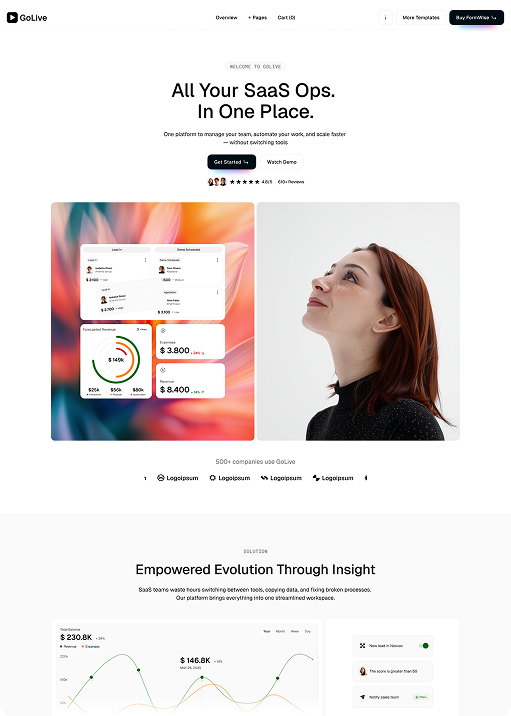
1. GoLive — Best for early-stage SaaS and product launches
Price: $169 | Pages: Multi-layout | Style: Light, Modern
GoLive is built for founders who need to look launch-ready from day one. The multi-layout structure gives you a clean homepage that positions your product clearly, a features section with space for UI screenshots, a pricing section built for tier comparison, and a blog CMS for content marketing.
What separates GoLive from generic startup templates is its attention to the SaaS sales sequence — the page flows from awareness to credibility to conversion in the order a first-time visitor actually needs. No reordering required.
Best for: Pre-seed to Series A SaaS startups, product launches, AI tools, and productivity platforms that need a credible site fast.
See live preview | Get GoLive — $169
2. Cloudis — Best for cloud software and B2B SaaS
Price: $169 | Pages: 23 | Style: Light, Modern
Cloudis is the most complete SaaS template in the Loonis portfolio — 23 pages covering every section a growing B2B software product needs: homepage, features, pricing, integrations, a blog CMS, about, and team pages. It has the depth of a product site, not just a landing page.
Best for: Cloud software platforms, developer tools, B2B SaaS products with multiple use cases or buyer segments, and Series A+ companies refreshing their site.
See live preview | Get Cloudis — $169
3. Flowis — Best for B2B SaaS with enterprise positioning
Price: $169 | Pages: 26 | Style: Light, Modern
Flowis is the largest template in the Loonis SaaS range at 26 pages — suitable for B2B software products that need the depth of an enterprise-ready site without a custom agency build. Enterprise SaaS buyers typically visit 4-7 pages before engaging with sales. Flowis's 26-page architecture gives them enough depth to self-qualify and build confidence without hitting dead ends.
Best for: B2B SaaS with enterprise positioning, workflow automation platforms, CRM and operations tools, and any software product selling into mid-market or enterprise.
See live preview | Get Flowis — $169
4. Lumis — Best for dark-mode SaaS and developer tools
Price: $169 | Pages: Multi-layout | Style: Dark, Modern
Lumis is the Loonis portfolio's dark-mode SaaS template — built for developer tools, cybersecurity platforms, AI infrastructure products, and any software brand where dark aesthetic signals technical credibility and modern engineering culture. Dark-mode design has become a strong trust signal in developer tooling, AI/ML platforms, and security software specifically.
Best for: Developer tools, API platforms, cybersecurity and compliance software, AI/ML infrastructure companies, and any SaaS brand whose primary buyer is a technical decision-maker.
See live preview | Get Lumis — $169
5. Structa — Best for IT agencies and digital service companies
Price: $169 | Pages: 20 | Style: Light, Modern
Structa is built for IT consultancies, digital agencies, and managed service providers — service businesses operating in the technology space rather than pure software products. Note: if you are a software product company rather than an IT services company, GoLive, Cloudis, or Flowis will better match your conversion requirements.
Best for: IT consultancies, managed service providers, digital transformation agencies, and software development studios.
See live preview | Get Structa — $169
6. Deploya — Best for AI startups and SaaS platforms with integrations ecosystems
Price: $169 | Pages: 25 | Style: Light, Modern
Deploya is the newest addition to the Loonis SaaS range, built specifically for AI startups, automation platforms, and SaaS products with integration ecosystems. The defining feature is a CMS-powered integrations directory — each tool, API, or platform your product connects to gets its own page, making ecosystem compatibility visible and searchable. Deploya is also the only Loonis SaaS template with native e-commerce capability, supporting usage-based pricing, credit systems, and direct product sales alongside standard subscription models.
Best for: AI startups, LLM-powered products, AI agent platforms, automation SaaS, developer tools with AI components, and any software company whose buyers evaluate integrations depth before engaging with sales.
See live preview | Get Deploya — $169
Choosing between GoLive, Cloudis, Flowis, Lumis, Deploya, and Structa comes down to three variables: your product stage, your target buyer, and your brand register. Early-stage with a consumer or SMB product: GoLive. Growing B2B product with multiple buyer segments: Cloudis. Enterprise-positioned software: Flowis. Developer tool or technical product: Lumis. AI startup with an integrations ecosystem: Deploya. IT or digital services agency: Structa.
What should a SaaS Webflow template include that others don't?
A SaaS-specific Webflow template should include four elements that generic business templates rarely provide: a pricing section with tier comparison, a CMS blog for content marketing, product screenshot sections designed for UI imagery, and an integrations or tech stack page. These are not cosmetic — they are structural requirements of how SaaS buyers evaluate products online.
Specifically check for:
- Pricing section with visual tier comparison and per-plan feature lists — not just a "contact us for pricing" CTA
- CMS blog with category filtering, author support, and featured post options — not just a static news page
- Screenshot or UI mockup sections in the hero and feature areas that display product interfaces cleanly
- Integrations or tech stack page showing compatibility with tools your buyers already use
- Demo or trial CTA architecture — the primary CTA should drive a low-friction next step (free trial or demo), not just a calendar booking
How much does a SaaS website cost in 2026?
A SaaS website in 2026 costs between $169 (Webflow template, DIY) and $50,000+ (custom agency build). The template-plus-customisation path — Loonis template at $169 plus Pro customisation at $1,495 — delivers a fully configured, conversion-optimised SaaS site in 5 business days for under $1,700 total. For a funded startup or a SaaS company preparing for a raise, this is the fastest credible path to a site that closes deals.
The average B2B SaaS visitor-to-lead rate sits at 1.5-2.5%, with top performers reaching 8-15% (SaaS Hero, 2026). A site that converts at 3% instead of 1.5% doubles your inbound lead volume from the same traffic. Getting the architecture right from day one is a customer acquisition investment, not a design cost.
- Template at $169 — DIY setup in 1-2 weeks
- Template plus Pro customisation at $1,495 — fully configured, branded site delivered in 5 business days
- Template plus Launch & Grow bundle at $2,295 — Pro scope plus 3 months of post-launch support
- Freelancer build — $3,000-$15,000, 6-12 weeks
- Agency build — from $15,000 — appropriate for Series B+ with complex integration or enterprise compliance requirements
Frequently asked questions
What Webflow template is best for a SaaS startup?
GoLive is the strongest starting point for early-stage SaaS — it is built for the startup buyer journey: clear value proposition, pricing, product proof, and a blog CMS. For B2B SaaS with multiple buyer segments, Cloudis's 23-page structure is more appropriate. For enterprise-positioned software, Flowis at 26 pages covers the depth enterprise buyers require before engaging with sales.
Do Webflow SaaS templates include a pricing page?
All Loonis SaaS templates include a pricing section, but the structure varies. GoLive and Cloudis include visual tier comparison pricing sections designed for self-serve SaaS. Flowis includes a pricing section better suited to a contact-sales or demo-request model. Check each template's live preview for the exact pricing layout before purchasing.
How long does it take to launch a SaaS website with a Webflow template?
DIY with light edits: 1-2 weeks for most non-technical founders. The most common delay is content — product screenshots, copywriting, and customer quotes — not technical setup. With Loonis Pro customisation ($1,495, 5-day delivery), a fully configured, content-populated site is delivered in 5 business days. A comparable freelancer build takes 6-12 weeks and starts at $3,000.
What is the difference between GoLive, Cloudis, and Flowis?
GoLive is optimised for early-stage SaaS with a clean, focused structure ideal for product launches and pre-seed to Series A companies. Cloudis is broader — 23 pages covering the full B2B software product site for growing companies with multiple use cases. Flowis is the deepest at 26 pages, suited to enterprise-positioned products where buyers self-serve through detailed feature, integration, and case study pages before engaging sales. All three are $169 and include Figma source files.
Can I use a Loonis SaaS template for a dark-mode brand?
Yes — Lumis is Loonis's dark-mode SaaS template, built for developer tools, AI/ML platforms, cybersecurity products, and any SaaS brand where a dark aesthetic signals technical credibility. GoLive, Cloudis, and Flowis are all light-mode templates, though all can be recoloured through the Webflow Designer or the included Figma source file.
The bottom line
Your SaaS website is not a brochure — it is a sales system. The right template gives you the structural foundation to communicate product value, qualify buyers, and drive trial or demo conversions without months of custom development.
GoLive is the strongest starting point for early-stage SaaS. Cloudis suits growing B2B software products. Flowis covers enterprise positioning. Lumis is built for technical brands. Deploya is built for AI startups and integration-led products.
If you want any of these live and configured in 5 business days, the Loonis Pro customisation service at $1,495 is the fastest path from template to a site that earns customers — or the Launch & Grow bundle at $2,295 includes 3 months of post-launch support. For ongoing AEO strategy and content management, Loonis Growth Plans cover this from $149/month.