Best Webflow Template for AI Agent Startups in 2026
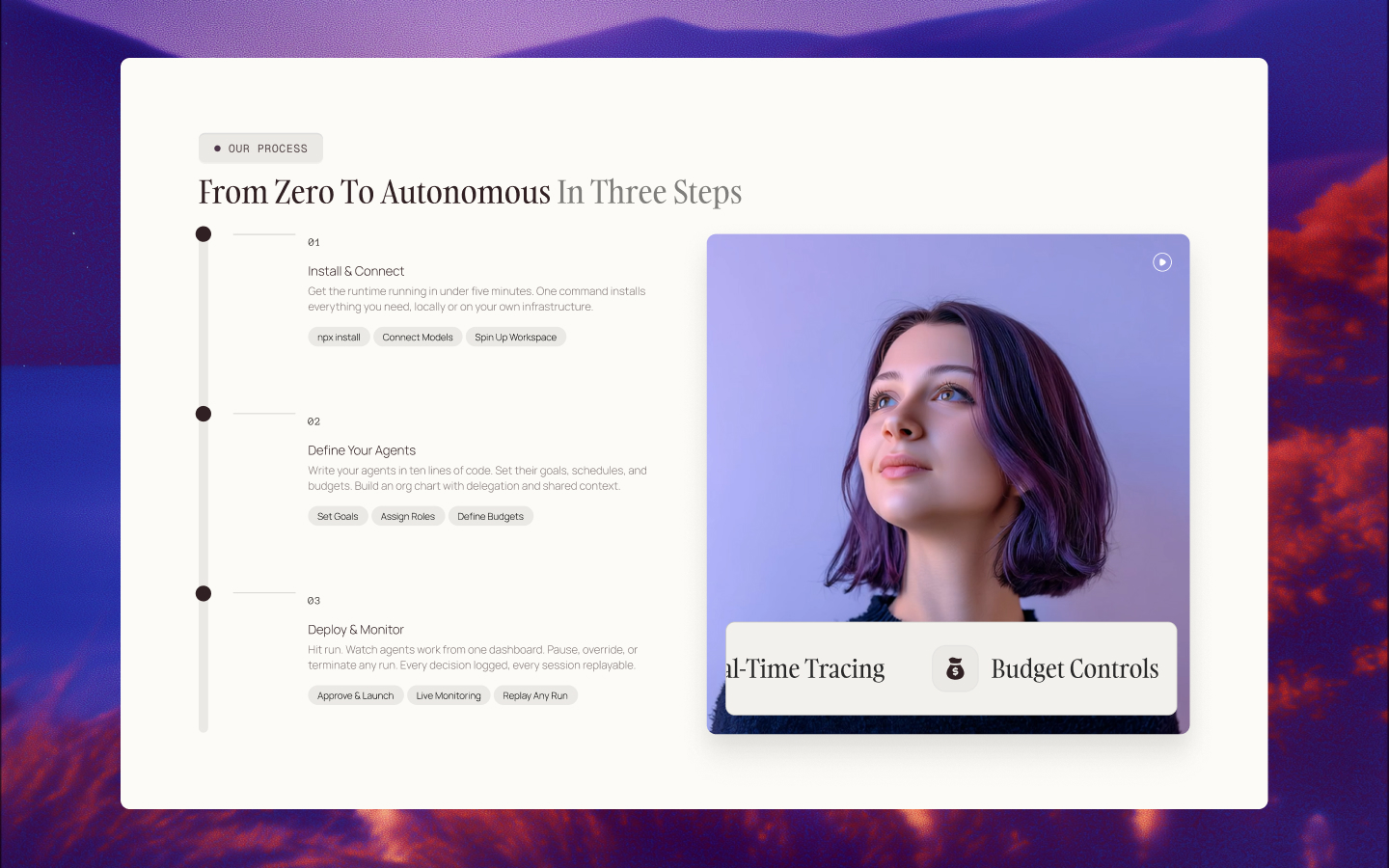
AI agent platforms have a website problem that generic SaaS templates cannot solve. Your buyers — technical evaluators, developer advocates, CTOs, and infrastructure decision-makers — arrive at your site already running a mental checklist: does this company understand autonomous workflows, does the product have real depth, and is this team legitimate or another wrapper on top of an API call? A site that answers these questions in the first ten seconds closes deals. A site that looks like a rebadged SaaS landing page from 2023 creates doubt before anyone reads a word.
RunLoop is the new Webflow template from Loonis built specifically for this buyer and this problem. It is not a general-purpose SaaS template with a dark mode option. It is purpose-built for AI agent startups, open-source devtools, and autonomous software teams — and every structural decision in its 60+ sections reflects what a technical evaluator needs to see before requesting a demo.
What is RunLoop and who is it built for?
RunLoop is a premium Webflow template for AI agent startups, open-source devtools companies, and autonomous software teams — 20+ pages, 60+ sections, three homepage variants, CMS-powered integrations, pricing, blog, and changelog, with a Figma file included. At $169, it is the only Webflow template in the Loonis portfolio designed specifically around the technical credibility signals that developer-adjacent and enterprise AI buyers evaluate. It is not a reskinned SaaS template. The information architecture, section hierarchy, and content structures are purpose-designed for the AI agent product vertical.
The buyer RunLoop is built for:
- AI agent platform founders building products where the buyer is a technical lead or CTO evaluating infrastructure, reliability, and ecosystem fit
- Open-source devtools companies where community trust, GitHub credibility, and documentation depth matter as much as the homepage headline
- Autonomous software teams shipping products to enterprise buyers who self-serve deep into technical specs, integration documentation, and use case depth before engaging with sales
- Developer tool startups where the site needs to communicate both the technical sophistication of the product and the accessibility of the onboarding path
If your AI product is pitched to non-technical buyers who evaluate based on outcome promises, RunLoop is not the right template. That audience is better served by Deploya or GoLive. RunLoop is built for the team whose buyer opens DevTools to inspect the site's code quality before deciding if the product is worth a trial.
See live preview | Get RunLoop — $169
What pages and sections does RunLoop include?
RunLoop includes 20+ pages and 60+ sections structured around the specific content architecture that AI agent and devtool products require: three homepage variants for different audience positioning, a CMS-powered changelog, a documentation or resources section, an integrations directory, a pricing section with subscription and usage-based variants, a blog, and individual feature and use case pages. The 60+ sections make it the most flexible Loonis template released to date — the section library covers every content pattern a technical product site needs without requiring custom development.
Key structural elements:
Three homepage variants. Not three colour options — three distinct information architectures built for three different audience positions. Homepage V1 is optimised for a product-led growth motion: trial or signup CTA, product demo or screenshot hero, social proof from developer communities. Homepage V2 is built for an enterprise or sales-led motion: outcome-focused headline, trust signals from enterprise clients, case study preview, and a demo-request CTA. Homepage V3 is open-source or community-led: GitHub star count, contributor community, documentation-first CTA, and a technical architecture section. Most AI agent companies need all three at different stages of growth. RunLoop ships with all of them.
Changelog section. Technical buyers and developer communities read changelogs. An active changelog signals that the product ships consistently, the team is transparent, and there is momentum worth betting on. RunLoop includes a dedicated changelog section with a structured layout designed for regular product updates.
Integrations directory. A dedicated section showing which tools, APIs, and platforms your product connects to. For an AI agent platform, this is often the highest-converting page after the homepage — a technical buyer evaluating whether your product fits their stack will check the integrations page before they check the pricing page.
Use case and feature pages. Individual pages for each major use case and feature set, not a single collapsed features section. Enterprise buyers self-serve through use case pages that speak to their specific role, industry, or workflow. The template includes CMS architecture for this that scales without requiring page-by-page manual builds.
Pricing section with subscription and usage-based variants. SaaS subscription, usage-based, credit-based, and hybrid pricing models are all covered in the pricing section architecture. No custom development needed to represent usage-based or seat-based pricing transparently.
How does RunLoop compare to Deploya?
RunLoop and Deploya are both Loonis templates for the AI and modern software product vertical, but they target different buyers and different products. Deploya is built for AI SaaS companies selling to business buyers through an integrations-led motion. RunLoop is built for AI agent platforms and devtool companies selling to technical buyers through a technical credibility motion. The distinction is the buyer's evaluation lens, not the product category.
The practical decision guide:
Choose RunLoop if: your primary buyer is a developer, technical lead, DevOps engineer, or CTO who evaluates products by reading documentation, checking your changelog, reviewing your GitHub, and asking about your agent architecture. Your product is an AI agent platform, an open-source devtool, an autonomous workflow engine, or developer infrastructure. RunLoop's 60+ sections and three homepage variants give you the flexibility to cover every technical content pattern without custom development.
Choose Deploya if: your primary buyer is a business decision-maker, operations lead, or non-technical founder who evaluates products by outcome metrics, integration compatibility with their existing SaaS stack, and case study results. Your product is an AI-powered SaaS tool, an automation platform, or a vertical AI application.
What makes a Webflow template credible for AI agent buyers in 2026?
For AI agent platforms and open-source devtools, website credibility in 2026 is earned through four specific signals: technical architecture transparency (a clear explanation of how the agent works, not just what it does), proof of shipping velocity (an active changelog), ecosystem fit documentation (an integrations directory with real depth), and community or adoption signals (GitHub stars, contributor count, or developer testimonials). A template that does not support these four content structures forces the product team to build them from scratch — which delays launch and often results in an incomplete implementation.
RunLoop ships with native CMS structures for all four:
Architecture transparency — Dedicated sections in the homepage variants and feature pages for technical architecture diagrams, agent workflow explanations, and "how it works" depth. These sections are designed to satisfy a technical evaluator without requiring a full documentation site.
Shipping velocity proof — The changelog section with date stamps and version tags. Updated regularly, this becomes one of the highest-engagement pages on a technical product site.
Ecosystem fit documentation — The integrations directory showing which tools and platforms the product connects to, with space for setup guidance and use case context.
Community and adoption signals — GitHub star count component, contributor community section, developer testimonial layout, and open-source project showcase. These are built into the Homepage V3 variant specifically.
How much does RunLoop cost and how do I get started?
RunLoop costs $169 one-time with a Figma source file included. Webflow CMS hosting adds $23/month. Total first-year cost for a self-configured site: approximately $445. With the Loonis Launch & Grow service ($2,295, 5-business-day delivery), a fully branded and content-populated RunLoop site is live in under one week. The Figma source file is sent within 1–2 business days of purchase on request via hello@loonis.co.
Three paths to launch:
DIY — Purchase RunLoop at $169, configure it yourself using Webflow's visual editor. Three homepage variants let you A/B test positioning without rebuilding the site. Timeline: 2–3 weeks for most non-technical founders. Best if you have a design-literate team member available.
Launch & Grow — Loonis Launch & Grow at $2,295 delivers a fully configured, branded, content-populated RunLoop site in 5 business days. Includes brand alignment, all page content, CMS setup, integrations directory population, changelog setup, and basic on-page SEO. Plus 3 months of post-launch support. Best for founders approaching a fundraise, press event, or product launch with a hard deadline.
Pro — Loonis Pro at $1,495 covers the core customisation scope in the same 5-business-day window without the extended post-launch support.
See RunLoop live preview | Get RunLoop — $169
Frequently asked questions
What is RunLoop and what is it built for?
RunLoop is a premium Webflow template by Loonis for AI agent startups, open-source devtools companies, and autonomous software teams. It includes 20+ pages, 60+ sections, three homepage variants for different audience positions (product-led, enterprise/sales-led, and open-source/community), a CMS changelog, a CMS integrations directory, use case and feature pages, and a pricing section supporting subscription and usage-based models. Priced at $169 with a Figma file included.
What is the difference between RunLoop and Deploya?
Both are Loonis AI and SaaS templates at $169. RunLoop is built for AI agent platforms and devtool companies whose primary buyer is a technical evaluator — developer, CTO, DevOps lead. Its defining features are the three homepage variants, the CMS changelog, and the technical credibility architecture. Deploya is built for AI SaaS companies whose primary buyer is a business decision-maker. Its defining features are the e-commerce capability and the integrations directory for business stack compatibility. Choose RunLoop for developer-adjacent buyers; choose Deploya for business buyers.
Does RunLoop include a Figma file?
Yes. A Figma source file is included with RunLoop and sent within 1–2 business days of purchase on request via hello@loonis.co. The Figma file includes all pages, components, and section structures, making it straightforward to design new sections or adapt the visual system before building in Webflow.
Can I use RunLoop without coding knowledge?
Yes. All editing happens through Webflow's visual designer — no code required for standard configuration. The CMS (changelog, blog, integrations directory) is managed through Webflow's content editor, which functions like a standard CMS with no design access required. For a fully configured site without handling the setup yourself, the Loonis Pro ($1,495) or Launch & Grow ($2,295) service delivers a ready-to-publish RunLoop site in 5 business days.
How many pages does RunLoop include?
RunLoop includes 20+ pages: three homepage variants, individual feature pages, use case pages, pricing page, integrations directory, blog (with CMS), changelog (with CMS), about and team pages, contact and demo request pages. The 60+ section library allows combining and adapting the template to cover additional content needs without custom development.
The bottom line
The AI agent startup market in 2026 does not reward generic. Technical buyers who evaluate infrastructure, developer tools, and autonomous software platforms are not convinced by a polished hero section and a pricing table. They are convinced by a changelog that shows you ship, an integrations directory that shows your ecosystem fit, and a site whose architecture signals that the people who built it understand the problem they are solving.
RunLoop is built for that buyer. Get it at $169 with a Figma file included, or have it configured and live in 5 business days with the Loonis Launch & Grow bundle at $2,295.
.png)
.jpg)