Best Webflow Templates for Interior Designers in 2026
Interior design is one of the most visually high-stakes professional categories online. A potential client searching for an interior designer evaluates the firm's website in the same breath as their portfolio — the site is not a directory listing, it is a design statement. A website that contradicts the quality of the work it is showing will lose the client before the portfolio is opened. A website that earns trust visually, communicates the firm's aesthetic clearly, and makes the inquiry path frictionless will convert those same visitors at a meaningfully higher rate.
This guide covers what an interior design website needs to convert clients, which Webflow templates are built for this specific market, and how to choose between them.
What does an interior design website need to convert clients?
An interior design website converts clients when it does three things simultaneously: communicates the firm's specific aesthetic and project type before a visitor reads a word, shows portfolio work with enough depth to demonstrate execution capability at the prospect's budget level, and makes the inquiry path match the emotional register of the work. A luxury residential interior designer and a commercial fit-out firm need different websites even if they both call themselves interior designers. The template, the layout, and the copy should communicate which one you are from the first viewport.
The five conversion elements specific to interior design:
1. Aesthetic coherence between the site and the work. A firm specialising in minimal Scandinavian residential interiors with a website using bright colours and decorative fonts is sending a contradictory signal. The site's visual register should feel like a natural extension of the work in the portfolio — not an afterthought.
2. Project portfolio with individual project pages. Not a gallery of images — individual project pages that include the brief, the scope, the design decisions, and the outcome. A client evaluating a firm for a $150,000 kitchen renovation wants to see that the firm has thought carefully about a kitchen renovation before, not just that it has photographed one.
3. Clear project type and budget positioning. Most interior design websites are deliberately vague about the types of projects and budgets they work with. This vagueness filters nobody out and converts nobody in. A firm that states its typical project scope — residential full-service from $75,000, commercial fit-out from $50,000 per 1,000 sqft — earns faster trust from qualified prospects and loses nothing from those outside that range who were never going to be good clients anyway.
4. Service structure for the specific engagement model. Interior design firms offer fundamentally different services: full-service residential design, e-design or online consulting, product sourcing, commercial fit-out, staging. Each has a different fee structure, timeline, and client relationship. A page that lists all services as bullet points under a single tab fails to communicate any of them clearly. Individual service pages with process descriptions and typical engagement terms convert significantly better.
5. Inquiry path that matches the quality level. A luxury design firm with a generic contact form asking for name, email, and message is sending a mismatched signal. A structured inquiry form that asks about project type, square footage, budget range, and timeline sends the signal that the firm takes its client qualification as seriously as its design work.
What is the best Webflow template for an interior designer in 2026?
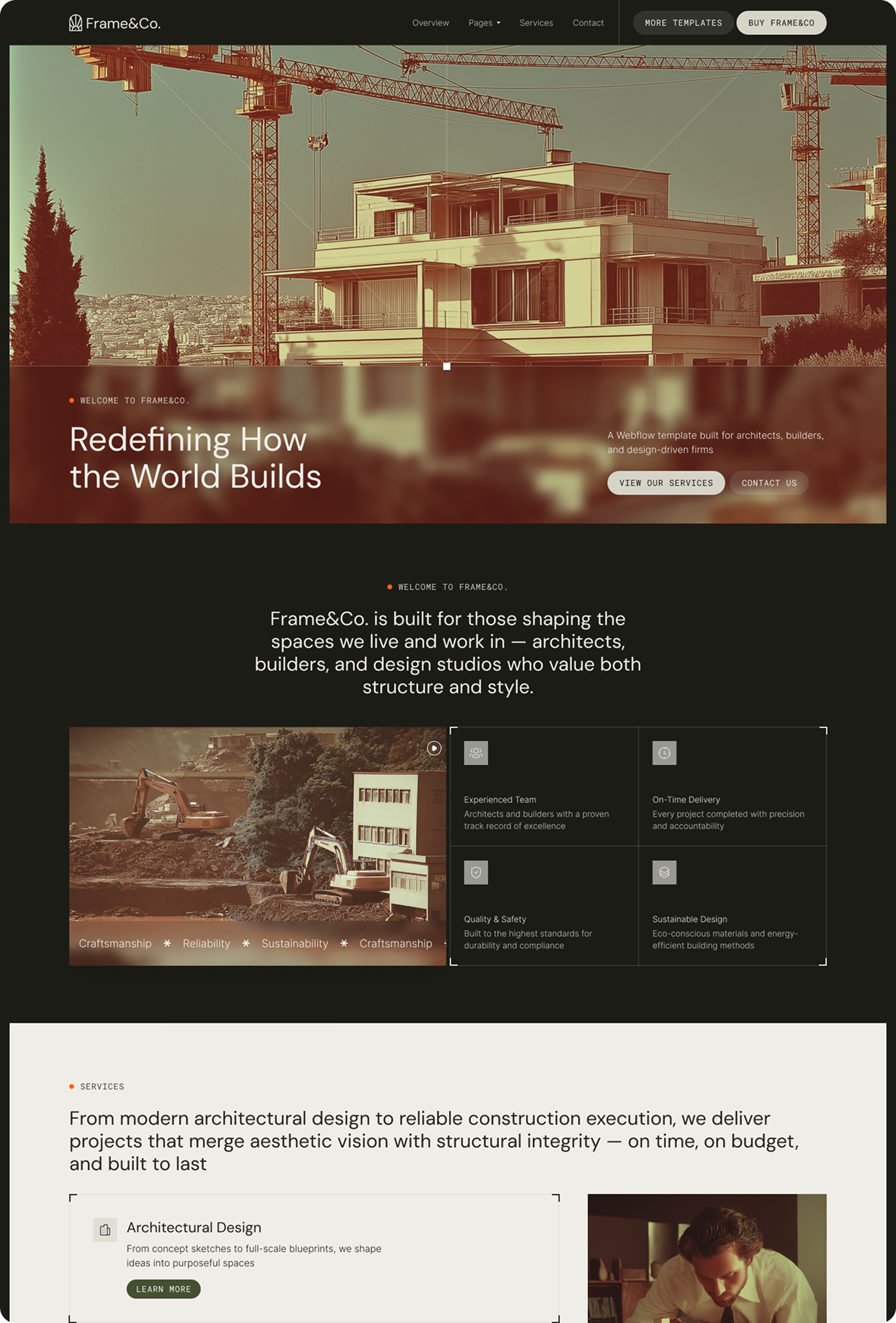
Frame&Co by Loonis is the strongest Webflow template for interior design practices, architecture-adjacent studios, and design-led firms in 2026 — 20+ pages built for portfolio-first presentation, with CMS-powered individual project pages, multiple layout variations, service and studio sections, and a Figma source file included at $169. It is not a generic business template with interior design copy dropped in. The visual register, the information hierarchy, and the page architecture are built around how a design-forward practice communicates its work to sophisticated clients.
What Frame&Co includes for interior designers specifically:
CMS-powered project portfolio with individual project pages. Each project is a CMS item with its own page: project type, scope, location, year, and a full photography showcase. Adding a new project, updating existing entries, or removing completed work is handled through Webflow's content editor with no design layer access required. A principal or studio coordinator can manage the portfolio day-to-day.
Multiple layout variations for different firm positioning. Frame&Co includes layout variations for different types of design practices — the editorial visual register suits firms positioning on design philosophy and aesthetic leadership; other layout options accommodate firms leading with project scale and commercial scope. The template does not force every interior design firm into the same visual hierarchy.
Studio and about section. A section for the studio philosophy, founding story, team members, and the firm's approach to client relationships. This is the page that converts — or loses — the prospect who is down to two or three firms. In design specifically, the personality and values of the studio matter as much as the portfolio at the final decision stage.
Awards and press section. Recognition from industry bodies (BIID, RIBA, AIA, Elle Decor, Architectural Digest) and press features are trust signals in interior design that have direct commercial value. A dedicated awards and press section, placed appropriately rather than buried in a sidebar, signals that the firm's work is recognised beyond its own client base.
Inquiry and contact flow. A contact page designed for structured inquiry capture rather than a generic form, with fields appropriate for a design engagement: project type, location, scope, and timeline.
See Frame&Co live preview | Get Frame&Co — $169
What pages should an interior design website include?
An interior design website needs six pages at launch: a homepage that communicates the firm's aesthetic and project type, a portfolio directory with CMS-powered individual project pages, individual service pages (not a single services list), a studio or about page with principal credentials and philosophy, a press or awards section, and a structured inquiry or contact page. Firms that launch with all six consistently outperform those that rely on a homepage and a projects gallery with a contact email.
The two most commonly underbuilt:
Individual service pages. Most interior design websites list services as bullet points: residential design, commercial design, e-design, staging. Each of those is a different engagement model with different client expectations, timelines, fees, and deliverables. A residential full-service client and an e-design client are not the same person and should not be on the same page. Individual service pages with clear process descriptions, typical timelines, and engagement terms convert each audience more effectively than a combined list.
Studio or about page with principal depth. In interior design, clients are hiring a specific person's taste, relationships, and judgment — not a company. A principal page that includes design education, prior experience (other studios, notable projects), awards, published work, and a personal design philosophy converts qualified prospects who have done their research. A page with a headshot and three sentences does not.
How does Frame&Co compare to a generic business template for interior design?
The structural difference between Frame&Co and a generic professional services template for an interior design use case is the same as the difference between a bespoke suit and an off-the-rack one in the right size: both fit, but one was made for you. Generic templates require rebuilding the information hierarchy, adding CMS collections that do not exist, and overriding visual defaults that were designed for different industries. Frame&Co ships with the portfolio architecture, the visual register, and the section types that a design-led firm needs by default.
Specific structural differences:
Portfolio CMS vs image grid. Generic templates often present portfolios as a static image gallery or a manually coded grid. Frame&Co's portfolio is a CMS collection — each project is a structured entry with fields for title, category, year, and photography. New projects appear in the portfolio grid automatically when added through the content editor.
Design-forward visual register. Frame&Co's typographic choices, spacing, and colour system are built for design-adjacent businesses. Generic templates default to corporate or startup visual registers that require significant design work to feel appropriate for a premium interior design firm.
Press and awards architecture. Frame&Co includes dedicated sections for press features and industry recognition. Generic templates typically have no equivalent — firms building on them either omit this trust signal entirely or create a workaround that looks inconsistent.
How much does an interior design website cost in 2026?
A professional interior design website built on Frame&Co costs $169 (template, DIY) to $1,919 (template plus done-for-you customisation in 5 business days). Custom design websites from specialist digital studios run $8,000–$30,000 and take 8–16 weeks. For most interior design studios — particularly those under 10 people — the template path delivers professional-grade visual output at a fraction of the custom build cost.
For a design practice generating $300,000–$1,500,000 in annual project revenue, a $1,919 website investment that converts one additional qualified inquiry per quarter pays for itself in a single project deposit.
Start with Loonis Pro — $1,750
In summary
- An interior design website converts clients through three simultaneous signals: aesthetic coherence between the site and the work, portfolio depth that demonstrates execution capability at the prospect's budget level, and an inquiry path that matches the quality register of the firm.
- Six pages at launch: homepage, portfolio directory with individual project pages, individual service pages, studio/about page, press/awards section, and structured inquiry page.
- Frame&Co by Loonis ($169) is built for design-forward firms: CMS project portfolio, multiple layout variations, studio section, awards architecture, and a Figma source file included.
- Total first-year DIY cost: approximately $445. With done-for-you configuration (Loonis Pro): $1,919 total in 5 business days. Custom studio builds: $8,000–$30,000.
- The most commonly underbuilt pages on interior design websites are individual service pages and a principal-depth about page — both of which carry disproportionate conversion weight in a relationship-led business.