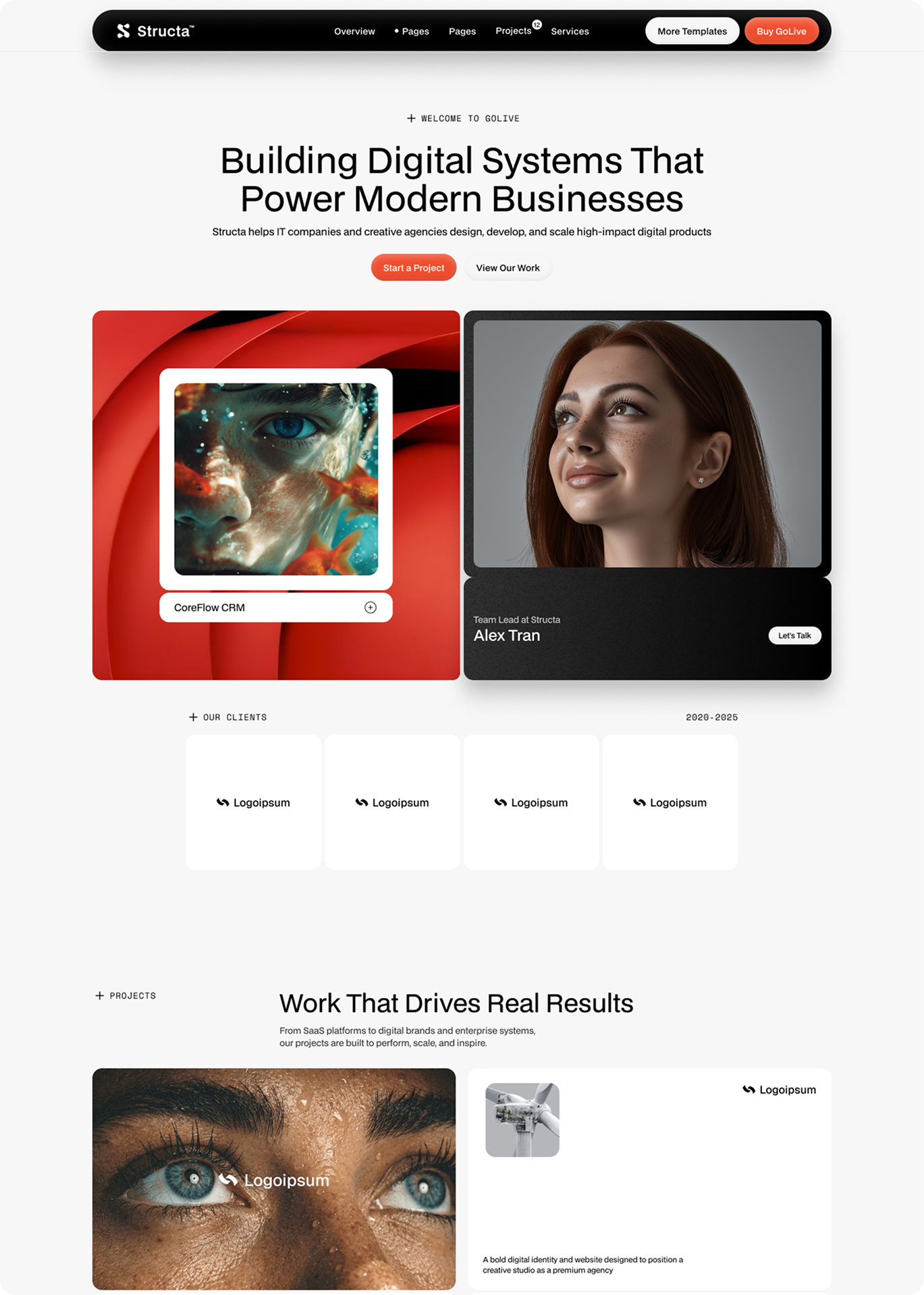
Best Webflow Templates for IT Companies and Digital Service Agencies

IT companies and digital service agencies have a website problem that most agency templates do not solve. The creative agency template market in 2026 is enormous - bold portfolios, full-bleed case study grids, editorial typography. But an IT consultancy, a managed service provider, or a digital transformation agency is not selling creative work. It is selling technical capability, delivery track record, and operational trust. A template built for a design studio communicates the wrong things to the buyers an IT company actually needs to reach.
This guide covers what an IT company or digital service agency website needs to convert enterprise and mid-market buyers, and which Webflow templates are built for this specific positioning.
What does an IT company website need that creative agency templates miss?
An IT company or managed service provider website needs four structural elements that creative agency templates rarely include: a services architecture that communicates technical scope rather than creative process, a team and certifications section showing individual technical credentials and vendor partnerships, case studies with measurable operational outcomes rather than design portfolios, and a security or compliance section that addresses the procurement questions enterprise buyers ask before engaging any technology vendor. Creative agency templates lead with visual work. IT company templates need to lead with capability and trust.
The four structural gaps:
1. Services architecture, not a single services page. An IT consultancy offering cloud migration, cybersecurity, managed services, and custom development cannot communicate four distinct service lines from a single page. Each service needs its own page with: what the service covers, who it is for, what the typical engagement looks like, what certifications or tools are used, and what outcomes past clients have achieved. Enterprise buyers evaluating IT vendors read these pages carefully.
2. Team certifications and vendor partnerships. Microsoft Gold Partner, AWS Advanced Partner, Google Cloud Partner, ISO 27001, SOC 2 - these credentials are the primary trust signals for IT companies and they belong in the navigation-visible hierarchy of the site, not in a footer. Individual team member pages should include certification lists alongside professional history. A team page with generic bios and LinkedIn URLs loses to a team page with specific technical credentials.
3. Case studies with operational outcomes. "We built a custom application for a retail client" is not a case study outcome. "Reduced order processing time by 73% and eliminated 12 hours of manual reconciliation per week for a 400-person retail operation" is. IT company case studies need to quantify the operational before-and-after, not describe the project scope. The buyers reading them are operations leaders who have been burned by technology projects that delivered on spec but not on outcome.
4. Security and compliance section. Enterprise and mid-market buyers run vendor security assessments as a standard procurement step. An IT company with no security information publicly visible is creating friction at the evaluation stage. A dedicated security page or section covering data handling policies, relevant certifications, insurance coverage, and the vendor assessment process removes that friction before the sales conversation begins.
What is the best Webflow template for an IT company in 2026?
Structa by Loonis is the strongest Webflow template for IT consultancies, managed service providers, digital transformation agencies, and software development studios in 2026 - 20 pages built for the information architecture that technology service buyers evaluate, with a deep services structure, team credential sections, a CMS case studies section, and a Figma source file at $169. It is positioned specifically for IT and digital services companies rather than adapted from a creative agency template.
What Structa includes for IT companies specifically:
Individual service pages. Each technology service the firm offers has its own page with scope, typical engagement structure, tools and platforms used, team credentials relevant to that service, and case study references. Not a single services overview with bullet points.
Team section with credential depth. Individual profiles with certification lists, vendor partnership credentials, technical specialisations, and relevant project history. Built to hold the credential depth that distinguishes an IT company from a generalist agency.
CMS case studies. Each case study is a CMS entry with its own page: client context, technical challenge, solution architecture, and measurable operational outcome. Updatable by a non-technical team member without Designer access.
Partners and technology stack section. A dedicated section for vendor partnerships (Microsoft, AWS, Google Cloud, Salesforce, ServiceNow) and technology certifications. Enterprise buyers evaluate technology partner status as a proxy for capability and commitment.
Blog and insights CMS. Structured for technical thought leadership - the content type that drives organic traffic from IT buyers researching vendors before making first contact.
See Structa live preview | Get Structa - $169
What pages should an IT company website include?
An IT company website needs seven pages at launch: a homepage that communicates technical capability and client scale in the first viewport, individual service pages per service line, a case studies section with CMS-powered individual case study pages, a team page with certification depth, a partners and technology stack page, a security and compliance section, and a contact page with a structured project inquiry form. Companies that launch with all seven and populate them with real client outcomes and team credentials consistently outperform those that launch with a homepage and a generic services list.
The two pages most commonly underbuilt:
Individual service pages. Most IT companies list all services on a single page to avoid the appearance of being a one-trick shop. This backfires with enterprise buyers who are evaluating vendors for a specific service category - they cannot quickly find the depth they need for their specific procurement need. Individual service pages allow each line to carry its own technical depth, certification references, and outcome evidence.
Security and compliance section. A prospect who is about to hand a technology vendor access to their infrastructure, data, or production systems wants to know that vendor has thought about security as seriously as they have. Companies that publish their security posture attract better-qualified enterprise inquiries and reduce the friction at the procurement stage.
How should an IT company website communicate technical expertise without losing non-technical buyers?
The right architecture for an IT company website layers technical depth under outcome-led surface copy: homepage and service page introductions communicate in business outcomes, while case study detail pages and team credential sections go as technical as the actual work requires. The CTO and the CFO both influence the vendor decision for a large IT engagement. The homepage should speak to both. The case studies and team pages can go as technical as the evaluating engineer needs.
The most common mistake: leading with the technology stack rather than the business outcome. "We use AWS Lambda, Kubernetes, and Terraform to build cloud-native architectures" tells an IT director what you know. "We reduced infrastructure costs by 41% and deployment time from three weeks to four hours for a 600-person financial services firm" tells them what you achieve. The capability evidence goes in the case study and team pages. The outcome evidence goes in the homepage hero and service page introductions.
How much does an IT company website cost in 2026?
A professional IT company or digital service agency website built on Structa costs $169 (template, DIY) to $1,919 total in year one (template plus Loonis Pro customisation, 5-day delivery). Custom technology company websites from specialist digital agencies typically run $10,000-$40,000 and take 8-16 weeks. For most IT companies under 100 people, the template path delivers the credential depth and service architecture that enterprise buyers evaluate at a fraction of the custom build cost.
For an IT company with average project values of $50,000+, a $1,919 website that converts one additional qualified enterprise inquiry per quarter pays for itself many times over.
Start with Loonis Pro - $1,750
In summary
- IT company websites fail when they adapt creative agency templates: the visual language signals the wrong type of work to enterprise and mid-market buyers evaluating technology vendors.
- Four structural elements distinguish an IT company site: services architecture with individual pages per service line, team and certification depth, case studies with measurable operational outcomes, and a security or compliance section.
- Structa by Loonis ($169) is built for IT consultancies, managed service providers, digital transformation agencies, and software development studios - 20 pages with individual service pages, credential-depth team section, CMS case studies, and partners section.
- The most effective IT company homepage leads with business outcomes, not technology stacks. Technical depth belongs in case studies and team pages, not the hero section.
- Total first-year cost: approximately $445 DIY or $1,919 with done-for-you configuration in 5 business days.