How to Build an AI Consulting Website That Wins Enterprise Clients in 2026

The AI consulting market reached $11.07 billion in 2025 and is growing at 26.2% annually (Grand View Research, 2026). Every week, new AI consultancies launch with strong technical credentials and a website that looks identical to every other management consulting firm from 2019. The visual language is wrong. The information architecture is wrong. And the buyer they are trying to win - a CTO, CDO, or VP of Data Science - reads that mismatch in under ten seconds and moves on.
Enterprise AI buyers evaluate vendors differently from other professional services buyers. This guide covers what that evaluation looks like and how to build a website that passes it.
What does an enterprise AI buyer actually evaluate on your website?
An enterprise AI buyer evaluates three things before any conversation: production record (what percentage of engagements reach deployment, not just delivery), technical depth (evidence of real AI engineering rather than strategy slides), and methodology transparency (a documented framework for how the firm works, not vague consulting language). Generic consulting templates answer none of these. The information architecture is built for management consulting, not AI implementation.
A CTO who has already failed one internal AI initiative and is evaluating external partners wants to know: what specifically did you build, what percentage of it is in production, and who did it. The website's job is to answer those questions before the first call is requested.
What pages does an AI consulting website need to convert enterprise buyers?
An AI consulting website needs seven pages at launch: a homepage leading with production metrics, individual service pages with methodology detail, a case studies section with deployment outcomes, an industry verticals section, a team page with individual technical credentials, a methodology or framework page, and a structured discovery call intake page. The case studies and methodology page carry the most commercial weight with enterprise buyers and are the two most commonly underbuilt.
The seven pages and their conversion jobs:
How should an AI consulting website communicate technical depth without losing non-technical buyers?
Layered architecture: the homepage and service pages communicate in business outcomes, while case studies and team pages go as technical as the actual work requires. Both the technical evaluator (CTO, Head of Data) and the business buyer (CEO, CFO, VP of Operations) will visit the site.
Business language at the top level. Homepage hero and service page introductions lead with outcomes: "reduce manual document processing by 85%", "cut demand forecasting error from 23% to 7%", "deploy an LLM handling 60% of tier-1 support volume".
Technical depth one level down. Case study architecture sections and team credential pages can include: model architecture decisions (fine-tuned vs RAG vs agentic), infrastructure choices, evaluation frameworks, and deployment constraints. Technical evaluators want this. Non-technical buyers scroll past.
Framework credibility in the middle. The methodology page sits between both audiences - structured enough to reassure the business buyer, technical enough to show the CTO that the firm understands AI deployment complexity.
What is the most common AI consulting website mistake in 2026?
Treating AI as the differentiator when production rate is the actual differentiator. According to McKinsey's 2025 State of AI report, only 22% of enterprise AI projects reach production. A firm that can credibly claim a materially higher rate with case studies to support it is in a different category from every firm that just lists AI capabilities.
Three specific mistakes that lose enterprise buyers:
Vanity metrics over production metrics. "200+ AI projects delivered" means nothing if most were strategy decks. An enterprise buyer who has been burned by an initiative that produced a report instead of a deployed system is evaluating specifically for production evidence.
Generic team bios. "15 years of technology consulting experience" is not an AI credential. Enterprise buyers want to know: where did this person train, what specific models have they deployed, and have they published anything on the techniques the firm claims to use.
No process documentation. An AI consulting firm with no published methodology is implicitly claiming their process is either proprietary or improvised. Neither reassures a risk-averse enterprise buyer.
Which Webflow template is best for an AI consulting firm in 2026?
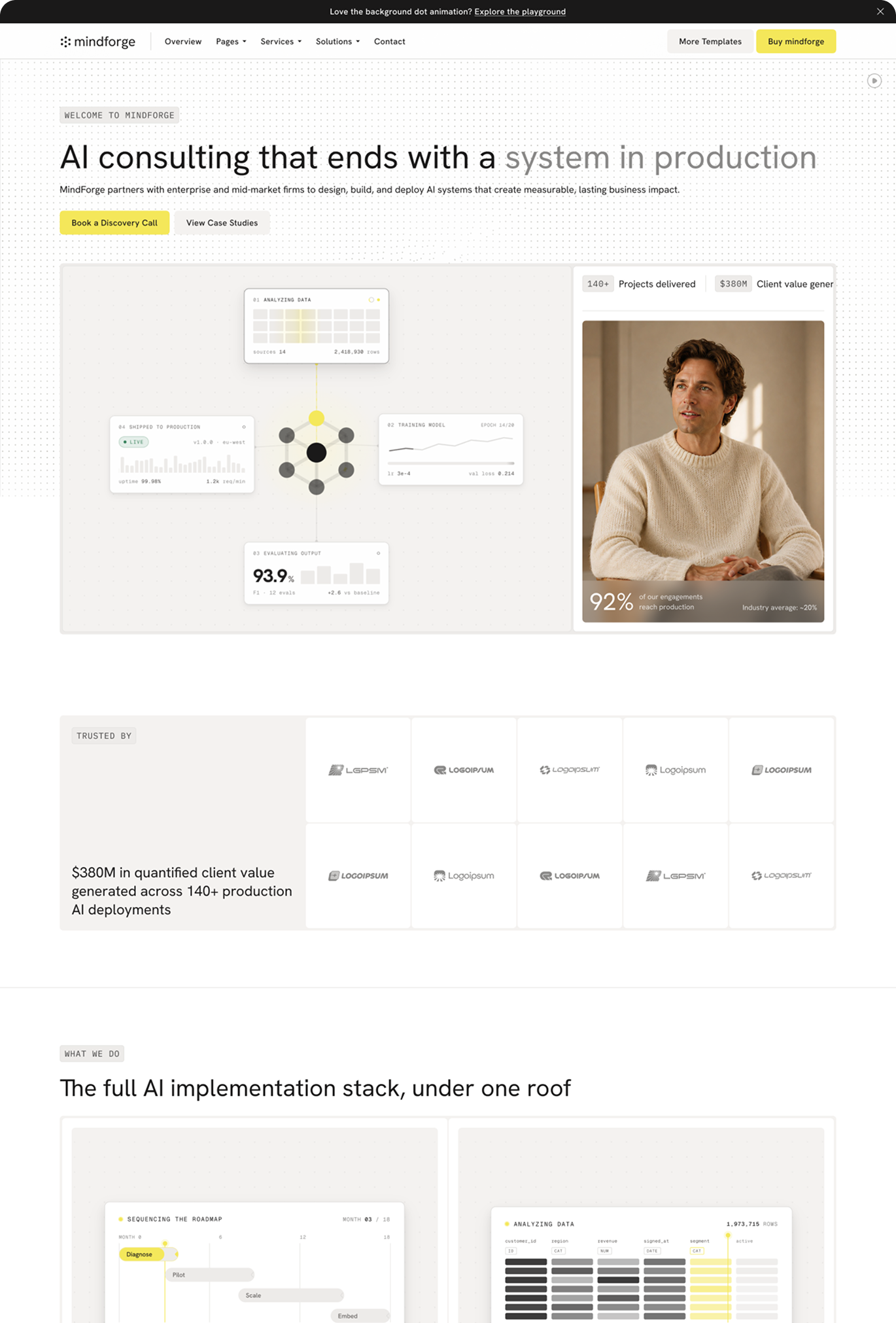
Mindforge by Loonis is the strongest Webflow template for AI consulting firms in 2026 - 18+ pages, multilayout, CMS case studies with individual deployment pages, CMS industry verticals, a five-phase methodology section, and a structured discovery call intake page at $169 with Figma file included. Built specifically for the information architecture enterprise AI buyers evaluate.
See Mindforge live preview | Get Mindforge - $169
Loonis Pro at $1,750 configures Mindforge with the firm's brand, case study entries, industry vertical pages, and team profiles in 5 business days from a complete brief.
In summary
- Enterprise AI buyers evaluate three things: production record, technical depth, and methodology transparency. Generic consulting templates answer none of these.
- Seven pages at launch - case studies with deployment outcomes and the methodology page carry the most commercial weight and are most commonly underbuilt.
- The most common mistake: listing AI capabilities when production rate is the differentiator. Only 22% of enterprise AI projects reach production (McKinsey, 2025). A firm with documented higher rates and supporting case studies is in a separate category.
- Layered architecture: business outcomes at the top level, technical depth in case studies and team pages, framework credibility in the methodology section.
- Mindforge ($169, Figma included) is purpose-built for this architecture. Pro configuration ($1,750, 5-day delivery) available.




%20(1).png)