


Best Webflow Templates for Coaching Businesses in 2026

A life coach in Barcelona lost a potential client to a competitor last month. The client had found both coaches through the same Google search, browsed both websites, and chose the one whose site made her feel understood — the one that spoke to her specific situation, reflected the coach's philosophy, and made booking a fit call frictionless. The coach in Barcelona never heard from her. The gap between the two coaches was not credentials, not methodology, and not price. It was the website.
The competition is sharper than ever. The global coaching industry reached $5.8 billion in 2026 and is projected to hit $9.5 billion by 2032 at an 8.53% CAGR (Simply.coach, 2026). ICF's 2025 Global Coaching Study counted 122,974 coach practitioners worldwide — a 54% increase since 2019, when there were just 71,000 (ICF, 2025). Executive coaching alone is a $103.6 billion market projected to reach $161.1 billion by 2030. 87% of organisations report positive ROI from coaching (ICF, 2025) — the demand is there, but so is every other coach competing for it. And the funnel itself is shifting: cold-call discovery conversion has dropped below 5% across most coaching niches, while the new application-first model converts at 30% to 55% on the application-to-purchase path (Communipass, 2026 Coaching Sales Funnel).
This guide covers the best Webflow templates for coaching businesses in 2026 — life coaches, business coaches, executive coaches, wellness coaches, training organisations, and educational programmes. Each template is reviewed on what actually drives client enquiries: whether it communicates your coaching philosophy clearly, whether it builds trust with a first-time visitor, whether it works with the application-first funnel and AI-assisted models that win in 2026, and whether it converts someone who is curious into someone who books a call.
What does a coaching website actually need to convert visitors into clients?
A coaching website needs six structural elements to convert: a clear niche statement above the fold (who you help, with what, and what changes after), an about page that leads with the client's problem rather than the coach's credentials, individual programme or service pages, social proof placed on service pages and the homepage, an application or booking flow that fits the 2026 funnel, and AI-readable content with question-based headings and named statistics. Coaching is a trust-first business. Clients are not buying a product they can return — they are making a vulnerable, often expensive decision to work with a specific person on something that matters deeply to them. The website's job is to make a stranger feel, within thirty seconds, that you understand their problem and that you are the right person to help them with it.
Most coaching websites fail this test in predictable ways — and the failure usually comes before the visitor reads a single service description. The most common and costly mistake is leading with the coach's credentials before the client feels understood. A homepage that opens with "ICF-certified coach with 15 years of experience" tells the visitor nothing about whether this coach understands their specific situation. A homepage that opens with "You know exactly what needs to change. You just can't seem to make it stick" speaks directly to the person who is ready to hire a coach.
This ordering — client's situation first, coach's credibility second — is the structural principle that separates high-converting coaching sites from ones that look professional but generate no enquiries. Every section of a coaching website should be evaluated against this principle.
Here is what a well-converting coaching site requires structurally:
- A clear niche statement above the fold. Who you help, with what specific challenge, and what life or work looks like after.
- An application form OR discovery booking flow. Calendly and Acuity embed cleanly into Webflow. Application forms (Typeform, Tally, Heyflow) embed just as easily and qualify leads before any human time is spent — increasingly the better choice as the discovery-call funnel degrades.
- Programme or service pages per offering. Each deserves its own page that speaks directly to that specific offer.
- Social proof placed where decisions are made. On service pages and the homepage, adjacent to where a visitor is deciding.
- An about page that leads with the client, not the coach. Problem first, then how the coach came to understand it, then credentials as evidence.
- A lead magnet or free resource. Email addresses are the long-term asset.
- A blog or content section. Coaches who publish consistent content build organic authority — and are increasingly the source AI systems cite.
- AI-readable structure. Question-based H2s, 40 to 60 word answer capsules, named statistics with sources, and FAQ schema.
How is AI changing coaching websites in 2026?
AI is now a baseline expectation in coaching, not an experimental edge — and coaching websites need to make the coach's AI position visible. Clients in 2026 use ChatGPT, Claude, and Perplexity to research coaches before they book. They expect coaches to articulate how AI fits into the practice (custom GPTs, between-session support, intake automation), they expect coaching websites to be readable by the AI systems doing that research, and they increasingly expect a hybrid offer where AI handles low-leverage interactions and the coach focuses on high-judgement work.
The category is moving fast. Custom ChatGPT GPTs trained on a coach's methodology are now monetisable products — clients access the GPT between sessions for accountability and quick reflection. Tools like Coachvox AI build full conversational AI versions of a coach. Elephas, Quenza, and CoachRx automate intake, journaling prompts, and progress tracking. The implication for the website is direct: coaches who do not signal an AI position read as either unaware of the shift or hostile to it — both of which lose informed clients to coaches who name their position clearly.
For most coaching sites, the practical AI signals are: a paragraph on the about page or services page explaining your AI position (whether you use AI between sessions, whether you offer a custom GPT, whether you keep the work strictly human), an AI-readable site structure (the same question-based H2s and answer capsules that win Google rankings in 2026), and a thoughtful FAQ pair on the topic. The Pathwise template is built with this structure in place.
Which Webflow templates are best for coaching businesses in 2026?
The strongest Webflow templates for coaching businesses in 2026 are Pathwise by Loonis (best for coaching programmes and training organisations), and a handful of marketplace and third-party options for coaches with different positioning needs. Pathwise leads on conversion architecture and learner-first hierarchy. Marketplace and third-party templates lead on entry price and niche-specific aesthetics.
1. Pathwise — Best for coaching programmes and training organisations
Price: $169 | Pages: 21 | Style: Light, Modern
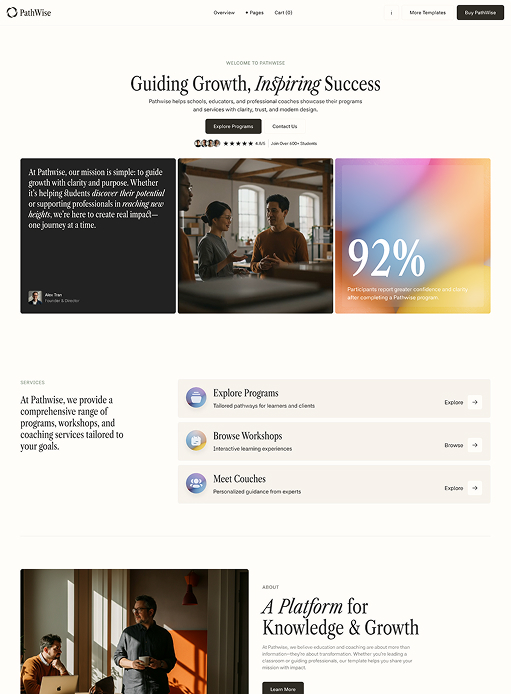
Pathwise is built on the insight that coaching clients decide to invest based on how a programme makes them feel, not how impressive its instructor sounds. The layout is clean, warm, and learner-first — a visual language that communicates clarity and safety rather than authority or pressure. Every section is structured around the coaching client's journey from awareness to decision, not around showcasing the coach's methodology.
The 21-page structure covers the full requirements of a professional coaching site: a homepage that leads with the client's transformation, individual programme pages with space for outcomes, curriculum overview, and investment details, a team or about section that balances personal story with professional credibility, testimonials woven throughout rather than siloed, a blog for thought leadership and organic search, lead capture sections, and a contact page with direct booking integration.
What separates Pathwise from generic templates is not just the design — it is the structural sequence. Where most coaching templates open with the coach's face and bio, Pathwise is designed to open with the client's world. The coach's credentials and story follow as evidence that the transformation is possible, not as the centrepiece of the pitch. This sequence is what actually converts a visitor who is considering coaching into an enquiry. Generic templates can be beautiful and still fail here because the architecture is wrong.
The programme pages also follow a question-and-answer structure that AI systems can extract cleanly when a prospective client asks ChatGPT or Perplexity about a specific coaching offer. The Figma source file is included with purchase.
Best for: Life coaches, business coaches, executive coaches, wellness coaches, personal development coaches, group programme hosts, training organisations, academies, workshop facilitators, and educational institutions whose clients are investing in their own growth.
See live preview | Get Pathwise — $169
2. Coach 128 by 128 Digital
Price: $99 | Style: Friendly, Multi-layout
A purpose-built coaching template with three homepage layouts and 26+ inner pages. Strong on options — service pages, events, success stories, and a CMS-powered blog. The aesthetic is warm and approachable; works well for life coaches and business coaches who want flexibility without committing to a single visual register. The trade-off is depth: programme pages are functional but less structurally sophisticated than Pathwise's learner-journey architecture.
Best for: Life and business coaches who want layout flexibility and a comprehensive page set at a mid price point.
3. Good Coach by Wavesdesign
Price: $89 | Style: Playful, Minimal
A premium coaching template with a playful-but-minimal aesthetic and subtle animations. Strong on visual personality, lighter on structural depth. Ships with CMS Services and Blog collections plus eCommerce capability for selling coaching programmes directly. Suits coaches whose brand leans toward warmth and creativity rather than gravitas.
Best for: Solo life coaches and freelance consultants whose brand identity is warm, creative, and personality-led.
4. Dristi by Pilgrims
Price: $79 | Style: Sleek, Modern
A modern, clean template with multiple homepages and service templates. Robust CMS coverage. Visual register sits between Pathwise's learner-first warmth and Coach 128's friendly accessibility — closer to professional coaching practices than personality-driven solo coaches.
Best for: Life and business coaches who want a professional aesthetic at a budget-friendly price.
5. Kiev by Metaone
Price: $69 | Style: Clean, Contemporary
Contemporary template tailored for coaches, mentors, and consultants. Lighter page count (~12) but covers the basics — homepage, about, services, blog. SEO optimisation built in. Suits early-stage coaching businesses with focused offers and limited content needs.
Best for: Solo coaches launching their first professional site at a low entry price.
6. Coaching templates on the Webflow Marketplace
Price: Free to $99 | Style: Varies
The Webflow Marketplace has a coaching and consulting section with a small but growing number of options. Quality varies significantly. Some are purpose-built for coaching; others are generic service business templates with coaching-themed copy swapped in.
Before buying any marketplace coaching template, check four things specifically: whether individual programme or service pages exist in the CMS, whether testimonials appear on service pages and the homepage rather than only on a dedicated page, whether the homepage leads with the client's situation or with the coach's credentials, and whether there is a structured booking or application path.
Best for: Coaches with tighter budgets who are willing to invest time evaluating live previews.
Which booking tools work best with a Webflow coaching site?
The best booking tools for a Webflow coaching site in 2026 are Calendly (general use), Acuity Scheduling (multi-session packages and complex intake), TidyCal (lower-cost alternative), and Typeform or Tally for application-first funnels. Webflow does not have native booking functionality — every major coaching booking and application tool embeds cleanly using Webflow's custom code embed feature. The right choice depends less on the booking tool and more on whether you are running a discovery-call funnel or an application-first funnel.
Calendly is the most widely used and the easiest to embed. Free plan available; paid plans start at $10/month.
Acuity Scheduling offers more sophisticated intake forms and package management. Starts at $16/month.
TidyCal is a lower-cost alternative that embeds cleanly and works well for coaches who need basic booking without the Calendly price point.
Typeform, Tally, and Heyflow are application-form tools — increasingly the better choice as the cold-discovery-call funnel degrades. Application-to-purchase paths convert at 30% to 55%, compared with cold discovery calls now below 5% (Communipass, 2026 Coaching Sales Funnel). A short application followed by a deliberately consultative 20-minute fit call qualifies leads, sets expectations, and respects everyone's time.
Kajabi and Teachable are not booking tools but are worth noting for coaches who sell online courses or digital programmes. Both integrate with Webflow marketing pages via embed; the course content lives on their platforms.
The practical setup for most coaches: an application form on a dedicated apply page, a Calendly or Acuity link sent only after the application qualifies, and a CTA in the navigation. This covers the main conversion paths without custom development and fits the 2026 funnel.
When should a coach launch a Webflow site versus hire a custom build?
Most coaches should launch on a Webflow template ($169) rather than commission a custom build until the niche is locked, the offer is stable, and the positioning has been tested in the market. A coaching business in its first 18 months almost always evolves. The niche narrows. The offer changes. The audience shifts. A $10,000 custom website built before this evolution has happened is a website that needs rebuilding within two years. A premium Webflow template gives you a professional, credible foundation that can grow with the business.
For most coaches, the right starting point is a template. The time investment is in content: your niche statement, programme descriptions, testimonials, about page, and photography. For most coaches, this is two to four weeks of work alongside client delivery.
- A Webflow template at $169 is the right starting point for most coaching businesses.
- A template plus done-for-you setup removes that time cost. Loonis's Pro customisation service delivers a fully configured, branded, content-populated site in 5 business days for $1,750.
- A freelancer build runs $2,000 to $8,000 and takes 4 to 10 weeks. Worth considering only for specific technical requirements a template cannot handle.
- A custom agency build starts at $8,000 and is rarely the right investment until the niche is validated and revenue justifies the spend.
Frequently asked questions
What pages does a coaching website need?
At minimum: a homepage with a clear niche statement and a direct path to booking or application, individual pages per programme or service, an about page that leads with the client's problem before the coach's story, a contact or booking page with calendar integration, and a blog or resources section. For coaches selling group programmes, add a dedicated sales page per programme with outcomes, curriculum overview, testimonials from past participants, and a clear enrolment or application path.
Is Webflow good for coaching websites?
Yes. Webflow's CMS handles blog content, programme pages, and testimonials cleanly and scales as your content library grows. The visual design capabilities support the warm, personal aesthetic coaching brands typically require. Performance is strong on mobile, where a significant share of coaching research happens. The only gap is native booking and course functionality, which is filled by embedding Calendly, Acuity, Typeform, or a course platform like Teachable.
Can I sell courses or digital products through a Webflow coaching site?
Not natively for course delivery. Webflow works best as the marketing and sales page layer, while course content is delivered through Teachable, Kajabi, Thinkific, or Podia. This combination gives you design-quality marketing pages without being limited by the visual constraints of course platforms.
How much does a coaching website cost in 2026?
A premium Webflow template runs $79 to $169. Add Webflow hosting at $23 per month. A booking or application tool adds $0 to $25 per month depending on the plan. Loonis's Pro customisation service delivers a fully configured site in 5 business days for $1,750, bringing total first-year cost to under $2,200. A freelancer build typically costs $2,000 to $8,000 and takes 4 to 10 weeks.
How is AI changing coaching websites in 2026?
Significantly. Clients use ChatGPT, Claude, and Perplexity to research coaches before they book, expect coaches to articulate an AI position (custom GPTs, between-session support, intake automation), and increasingly favour coaches who offer hybrid AI-plus-human models. Coaching websites need to be structured for AI extraction — question-based H2s, 40 to 60 word answer capsules, named statistics, FAQ schema — and should include a visible paragraph or section explaining the coach's AI position. Pathwise is built with this structure in place.
Should coaches use discovery calls or application forms in 2026?
Application-first funnels increasingly outperform cold discovery calls. Cold-call coaching conversion has dropped below 5% across most niches, while application-to-purchase paths convert at 30% to 55% (Communipass, 2026 Coaching Sales Funnel). The 2026 model is: a short application that qualifies prospects, a 20-minute deliberately consultative fit call only after the application qualifies, and a transparent price/scope conversation. Tools like Typeform, Tally, and Heyflow embed cleanly into Webflow.
Does my coaching website need to be optimised for AI search?
Yes. With clients increasingly using ChatGPT and Perplexity to research coaches before booking, AI Overview optimisation is now a baseline coaching marketing channel. The mechanics: question-based H2 headings, 40 to 60 word answer capsules below each H2, named statistics with sources, structured FAQ pairs, and FAQPage / Article JSON-LD schema. Pathwise is built with this structure in place.
In summary
- A coaching site is a trust document. Lead with the client's problem. Credentials follow as evidence.
- Coaching is $5.8B in 2026, $9.5B by 2032 (Simply.coach). 122,974 coaches worldwide — 54% growth since 2019 (ICF).
- AI is baseline now. Articulate your AI position. Make the site AI-readable.
- Cold discovery calls now convert below 5%. Short apply-first forms convert at 30% to 55% (Communipass, 2026).
- Pathwise is the right pick for coaching programmes and training organisations. $169 with Figma source files.
- A template plus done-for-you setup runs under $2,200. A freelancer build runs $2,000 to $8,000.
For coaching businesses, the website is the first coaching experience a potential client has with you. The right template gives you the structure to make that experience feel personal, credible, and clear — without months of build time or an agency invoice that outpaces your current revenue.
Pathwise is the strongest choice for coaches, training organisations, and educational programmes whose clients are investing in their own growth and need to feel understood before they book. If you want the site live in five days without it competing with your client work for time, the Loonis customisation service is the fastest path from template purchase to a site that generates enquiries.





%20(1).png)

