


Best Webflow Templates for Wellness Businesses, Health Coaches and Therapists in 2026
.png)
The wellness industry reached $6.8 trillion globally in 2024, growing at 7.9% year-on-year (Global Wellness Institute, 2025). Mental wellness alone is expanding at 12.4% annually — the second-fastest growing wellness segment. For the 128,000 health coaches and 400,000-plus therapists in the US, that growth creates a straightforward problem: more buyers are searching online, and the website is the thing that determines whether they make contact.
Most wellness website guides focus on aesthetics — calming colours, clean fonts, warm photography. Those things matter second. What matters first is conversion architecture: does the site answer the four questions a potential client is evaluating before booking?
What does a wellness, health coaching or therapy website need to convert clients?
A wellness website converts potential clients when it answers four questions before the booking button: who specifically do you help, what does the process look and feel like, what changes after working with you, and are you a real credentialled person I can trust? Sites that answer all four in the first two scrolls consistently outperform sites with beautiful photography but vague copy. The global wellness market's growth has made the category crowded — buyers are more discerning, not less, and the website is the primary filter before a discovery call.
The four conversion elements in order of impact:
1. Niche clarity above the fold. "I help ambitious women heal their relationship with food" converts better than "holistic wellness for a better you." The more specific the statement, the faster the right client self-selects and the wrong client moves on. Both outcomes are good. Generic headlines waste everyone's time.
2. Process transparency. A potential coaching or therapy client is making a trust decision, not a product purchase. Explaining what happens in a session, what the engagement arc looks like, and what the client actively does (versus what the practitioner does) reduces the anxiety of first contact significantly.
3. Outcome specificity. "Feel better" is not an outcome. "Most clients report sleeping through the night and reducing their daily cortisol response within the first eight weeks" is an outcome. Specific, honest, and earned.
4. Real credibility signals. A professional photo (not a stock image), named credentials (certification body, training hours, specialisations), and testimonials placed on service pages rather than on a separate testimonials page. Credibility placed adjacent to the decision moment converts; credibility siloed in a tab is ignored.
According to Stanford Web Credibility Research (B.J. Fogg), 75% of people assess a company's credibility based primarily on website design. In wellness specifically, design is a trust signal before a word is read.
Which Webflow template is best for a health or wellness coach in 2026?
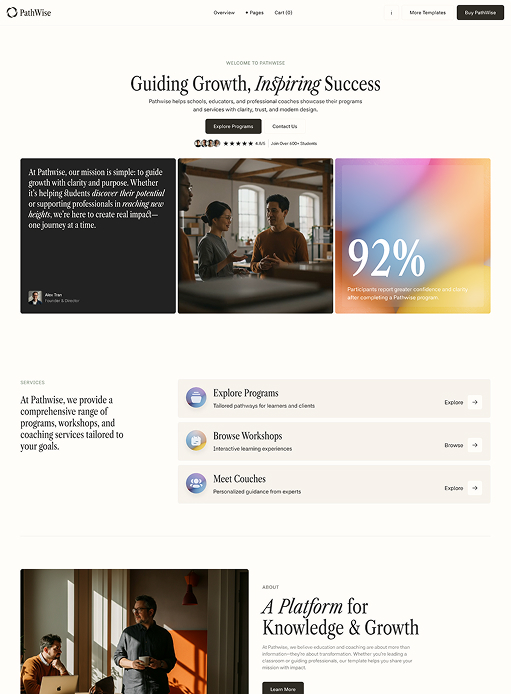
Pathwise by Loonis is the strongest Webflow template for health coaches, wellness coaches, holistic practitioners, and coaching programs in 2026 — 21 pages built around a client-transformation-first architecture, with individual programme pages, a booking-ready contact flow, testimonial placement on service pages, a CMS blog, and a Figma source file included at $169. It is the right template for practitioners whose business model is direct-to-client coaching: individual sessions, group programmes, online courses, or membership-based wellness offerings.
What Pathwise includes for wellness coaches specifically:
Individual programme pages. Each coaching programme or service has its own page with process description, session format, programme outcomes, client requirements, and a booking or inquiry CTA. Not a single services list — individual pages that allow each programme to carry its own testimonials and outcome statements.
Client transformation narrative. The homepage architecture is structured around the client's journey rather than the practitioner's credentials. Credentials appear as supporting trust signals, not the lead. This is the pattern that converts in health and wellness coaching: the client needs to see themselves in the outcome before they care about the practitioner's training hours.
Booking-ready contact flow. A multi-field inquiry form that captures what the client is dealing with, what they are hoping to achieve, and their preferred format (1:1 sessions, group programme, online) before the first call. This filters qualified clients and gives the practitioner context before a discovery conversation.
CMS blog for thought leadership and AEO. A blog section structured for authority content: question-based post titles, answer-forward structure, and individual post pages with full meta control. Health coaches who publish consistently on their specific area of expertise attract more qualified organic and AI-search traffic than those who rely on booking platforms alone.
E-commerce for courses and programmes. Native Webflow e-commerce allows selling online courses, workshop access, and programme bundles directly from the site without a third-party platform.
See Pathwise live preview | Get Pathwise — $169
Which Webflow template is best for a clinical wellness centre or multi-practitioner practice?
Sanaris by Loonis is the strongest Webflow template for clinical wellness centres, functional medicine practices, multi-practitioner wellness organisations, and medtech-adjacent wellness brands in 2026 — 21 pages built around patient-first credibility architecture, with individual practitioner pages, a services directory, a dedicated trust and accreditations section, and a Figma source file at $169. It is the right template for wellness organisations whose clients are evaluating clinical credentials, insurance or payment options, and institutional legitimacy before booking.
What Sanaris includes for clinical wellness specifically:
Individual practitioner profiles. Each practitioner has their own page with full credential detail: training institution, certification body, specialisations, approach philosophy, and a direct booking or inquiry path. This is the page a potential client navigates to before calling the centre — it should hold the depth to make that call feel confident rather than necessary.
Services directory with individual service pages. Each service (acupuncture, functional medicine consultation, IV therapy, nutrition counselling) has its own page with what the service involves, who it is for, what to expect in a session, and pricing or insurance information. Not a bulleted list — individual pages that allow each service to carry its own credibility context.
Trust and accreditations section. A dedicated section for regulatory registrations, professional body memberships, insurance accepted, and any clinical certifications relevant to the practice. Placed on the homepage and on a dedicated credibility page — not in the footer.
Patient-first design register. Calming, clinical, professional. Not corporate-healthcare cold. The design system is built for the specific emotional register a wellness centre needs: trustworthy enough to feel safe, warm enough to feel welcoming.
See Sanaris live preview | Get Sanaris — $169
How do Pathwise and Sanaris compare for wellness businesses?
The decision between Pathwise and Sanaris comes down to one question: is your business model direct-to-client coaching and programmes, or is it a multi-service clinical or wellness centre? Both are $169 with Figma source files. The structural difference reflects the different trust architecture each buyer type evaluates.
What pages should a wellness or health coaching website include?
A wellness business website needs six pages at launch: a homepage with a specific niche statement and outcome-led copy, individual service or programme pages, a practitioner or about page with credential depth, testimonials embedded in service pages (not siloed), a blog for authority content, and a contact or booking page with a structured inquiry form. Wellness businesses that launch with these six and nothing else consistently outperform those that launch partial sites with the intention of adding pages later.
The most common wellness website failures at launch:
Generic homepage headline. "Welcome to my wellness practice" or "I believe in holistic healing" tells a potential client nothing. The homepage headline should name who you help, what you help them with, and what they get. Specific enough that the wrong client knows to leave.
Testimonials on a separate page. Testimonials have conversion power when placed at the decision moment: on the service page, adjacent to the booking CTA, or directly below the outcome statement. On a separate "testimonials" tab, they are rarely seen and convert nothing.
No booking path without form submission. Wellness clients are often in a vulnerable or uncertain emotional state. A friction-heavy booking process (call to get a quote, no calendar visible, no idea of cost before contacting) creates enough hesitation to lose the appointment. A visible booking link, a clear pricing or "investment" statement, and a structured inquiry form that confirms the appointment process all reduce that friction.
Healthcare and wellness conversion rates average 3.0-4.2% (First Page Sage, 2026) with top-performing practices reaching 8-10%. The gap between average and top performer is almost always in the booking flow and niche clarity — not in the visual design.
How much does a wellness business website cost in 2026?
A professional wellness website built on Pathwise or Sanaris costs $169 (template, DIY) to $1,919 (template plus Loonis Pro customisation: fully configured, branded, content-populated site in 5 business days). Custom agency builds for wellness and healthcare websites typically run $8,000–$25,000 and take 8–16 weeks. For most solo practitioners, coaches, and small wellness centres, the template-plus-customisation path delivers professional credibility at a fraction of the custom build cost.
Total first-year cost:
- Template only (DIY): $169 + Webflow hosting $23/month = approximately $445 first year
- Template + Loonis Pro ($1,750, 5-day delivery): $1,919 total first year
- Template + Loonis Premium (from $2,900, discovery call required): for wellness centres needing custom booking integrations, membership portals, or e-commerce at scale
- Custom agency build: $8,000–$25,000 + 8–16 weeks
For a health coach or wellness practitioner generating $5,000–$20,000/month, a $1,919 investment that converts one additional client per month pays for itself in weeks.
Start with Loonis Pro — $1,750
In summary
- Wellness websites convert on four things: niche clarity above the fold, process transparency, outcome specificity, and real credibility signals adjacent to the decision moment — not aesthetics alone.
- 75% of people assess credibility through website design (Stanford Web Credibility Research). In wellness, design is the first trust signal before a word is read.
- Pathwise ($169) is built for health and wellness coaches, holistic practitioners, and coaching programmes: transformation-first architecture, individual programme pages, multi-field inquiry flow, e-commerce for courses.
- Sanaris ($169) is built for clinical wellness centres, functional medicine practices, and multi-practitioner organisations: credential-first architecture, individual practitioner pages, services directory, accreditations section.
- Total first-year DIY cost is approximately $445. Professional configuration with Loonis Pro runs $1,919 total in 5 business days.





%20(1).png)

