How to Build a SaaS Website That Converts in 2026: The Non-Technical Founder's Playbook
%20(1).png)
The median SaaS landing page converts at 3.8% — a full 42% below the all-industry median of 6.6%, based on Unbounce's analysis of 41,000 landing pages and 57 million conversions. That gap represents thousands of visitors who land on a SaaS website, see something that fails to resonate, and leave. The structural decisions made at the start — which pages to build, how to sequence the value proposition, where to put the pricing, what the hero section says — determine which side of that gap a site lands on from day one.
This guide covers how to build a SaaS website that converts, written specifically for founders who are not designers or developers. No jargon. Specific page-by-page decisions, with the reasoning behind each.
What pages does a SaaS website need to convert in 2026?
A SaaS website needs seven pages at launch: a homepage with a single clear value proposition, a features page structured around outcomes not capabilities, a pricing page with published numbers, individual use case or ICP pages, a social proof section, a blog for authority content, and a demo or trial signup page. Founders who launch with these seven consistently outperform those who launch with a homepage and a contact form. Each page has a specific conversion job, and none can do another's job.
The seven pages and what each must accomplish:
Homepage. One job: communicate what the product does, for whom, and what changes after using it — in under five seconds. The most successful B2B SaaS homepages in 2026 answer three questions in the first viewport: What problem do you solve? What is your product? Who is it for? (GenesysGrowth, 2026). Notion's homepage reads "Write. Plan. Share." Stripe leads with "Financial infrastructure for the internet." Neither describes a feature. Both describe what the visitor gains.
Features page. Not a list of capabilities — a page structured around outcomes. Feature - benefit - outcome. "Automated reporting" is a feature. "Your ops team stops building reports manually" is a benefit. "Your ops team spends those hours on work that moves the number" is the outcome. Buyers justify to other stakeholders using outcomes, not features.
Pricing page. A pricing page that hides its numbers loses the buyers you want most: high-intent, self-serve visitors who are ready to evaluate now and do not want to book a sales call first. Showing pricing — even as a starting range — removes friction for self-serve buyers and pre-qualifies enterprise leads who reach out (Orbix Studio, 2026).
Use case or ICP pages. A B2B SaaS product used by three different buyer types needs three different pages, each speaking to the specific workflow and outcome for that persona. High-converting SaaS websites use dedicated landing pages designed specifically for different ICPs to deliver targeted experiences (Pixlogix, 2026).
Social proof. Not a testimonials page nobody visits — social proof woven into every page at the decision moment: on the pricing page, on the features page, on the homepage with specific outcome data rather than just company logos.
Blog. Authority content that answers the questions your buyers ask before they know your product exists. This is also the primary AEO layer — 94% of B2B buyers now use AI in their purchase process (Forrester, 2026), and a blog structured with question-based headings and direct answer capsules earns AI citations.
Demo or trial page. The final conversion point. Reduce every source of hesitation: what happens after signup, how long to see value, what the commitment is. Include a 90-second product walkthrough, specific time-to-value statements, and a testimonial from someone who describes their initial hesitation.
What should a SaaS homepage hero section include?
The SaaS homepage hero must contain four elements in order: a single-sentence value proposition naming the buyer, the problem, and the outcome; a supporting sub-headline adding specificity; a product screenshot or short interactive demo; and one primary CTA. A hero section that leads with the company name and a tagline fails all four criteria simultaneously. The hero is the first yes or no a visitor gives the product — it is not a branding exercise.
The copy principle with the highest conversion impact: simple language over technical language. Pages written at a 5th-to-7th grade reading level convert at 12.9%. Pages using professional or complex copy convert at 2.1% — a 514% performance gap tied to copy simplicity alone (Unbounce, via Lovable, 2026). This is counterintuitive for technical founders who have spent years developing expertise. The buyer is not evaluating expertise in the hero. They are deciding in three seconds whether to read further.
The visual element matters as much as the copy. In 2026, the highest-converting SaaS websites embed interactive product demos directly into marketing pages, allowing visitors to experience the core workflow before signing up (Spike AI, 2026). For founders who cannot build an interactive demo in the first iteration: a short annotated screenshot highlighting the one workflow that solves the primary buyer pain is significantly better than a generic product overview image.
What is the right pricing page structure for a SaaS product in 2026?
A SaaS pricing page converts when it includes visible pricing numbers, three tiers framing the decision around buyer size rather than feature bundles, a FAQ section addressing the top four objections (contract length, cancellation, data ownership, support), and a testimonial from a customer at the middle-tier price point. The pricing page is the highest-intent page on any SaaS website — visitors who reach it have already evaluated the product and are in the process of justifying the purchase.
Three pricing page decisions that kill conversion:
Hiding prices. Qualified buyers who want to self-serve will not book a sales call to find out if the product is in budget. They will find a competitor that shows pricing. The high-intent self-serve buyer — the one who could close today — is lost.
Feature-differentiating tiers instead of buyer-differentiating tiers. Tier the product by who the buyer is. The decision should be obvious for each buyer type without reading the full feature list.
No FAQ on the pricing page. The four questions that kill SaaS conversions at the pricing stage: What happens to my data if I cancel? Can I change plans mid-year? Is there a minimum contract? What does support response look like? A FAQ section directly below the pricing table removes the final hesitation points without requiring a sales conversation.
Which Webflow templates are best for a SaaS website that converts?
The best Webflow templates for SaaS websites in 2026 are built around the page architecture above — homepage with a single value proposition, features structured as outcomes, visible pricing, use case pages, and a blog CMS — rather than generic layouts adapted for SaaS with placeholder content. From our experience building and analysing SaaS templates across the Loonis portfolio, the highest-converting templates share three structural features: a hero section built for a single CTA, a pricing section with a native tier structure, and a blog CMS set up for AEO content from day one.
Loonis SaaS templates by positioning:
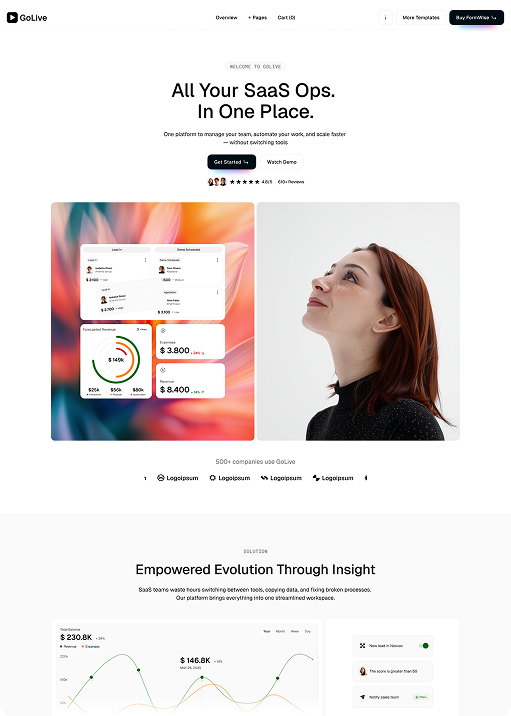
GoLive — best for early-stage SaaS founders who need launch-ready credibility fast. The highest CVR in the Loonis SaaS portfolio.
Cloudis — best for B2B SaaS with an established product positioning a feature-rich platform.
Deploya — best for AI-powered SaaS and integration-heavy platforms.
Lumis — dark mode, best for developer tools and technical SaaS.
All four include Figma source files. See the full SaaS template range.
How do you get a SaaS website live in 5 business days?
A SaaS website built on a premium Webflow template can be live in 5 business days when three inputs are ready before day one: the value proposition headline, the pricing structure, and the primary use case in plain language. The technical configuration is the fastest part. The copy decisions are the bottleneck.
Founders who arrive at the build phase with positioning committed and copy drafted in a document — not in their head — launch in days rather than weeks.
Loonis Pro at $1,750 delivers a fully configured, branded, content-populated SaaS website in 5 business days from a complete brief.
In summary
- The median SaaS landing page converts at 3.8% — 42% below the all-industry median. The structural decisions made at launch determine which side of that gap a site lands on.
- Seven pages at launch: homepage, features as outcomes, pricing with visible numbers, ICP-specific use case pages, social proof throughout, blog, and demo/trial page.
- Simple language converts 6x better than complex copy: 12.9% vs 2.1% (Unbounce, 2026).
- The pricing page is the highest-intent page on any SaaS site. Hiding prices loses self-serve buyers who were ready to convert today.
- GoLive, Cloudis, Deploya, and Lumis are Loonis's four SaaS templates, from $169 with Figma files included.
- A fully configured SaaS website can be live in 5 business days with Loonis Pro at $1,750 when positioning and copy are committed before day one.