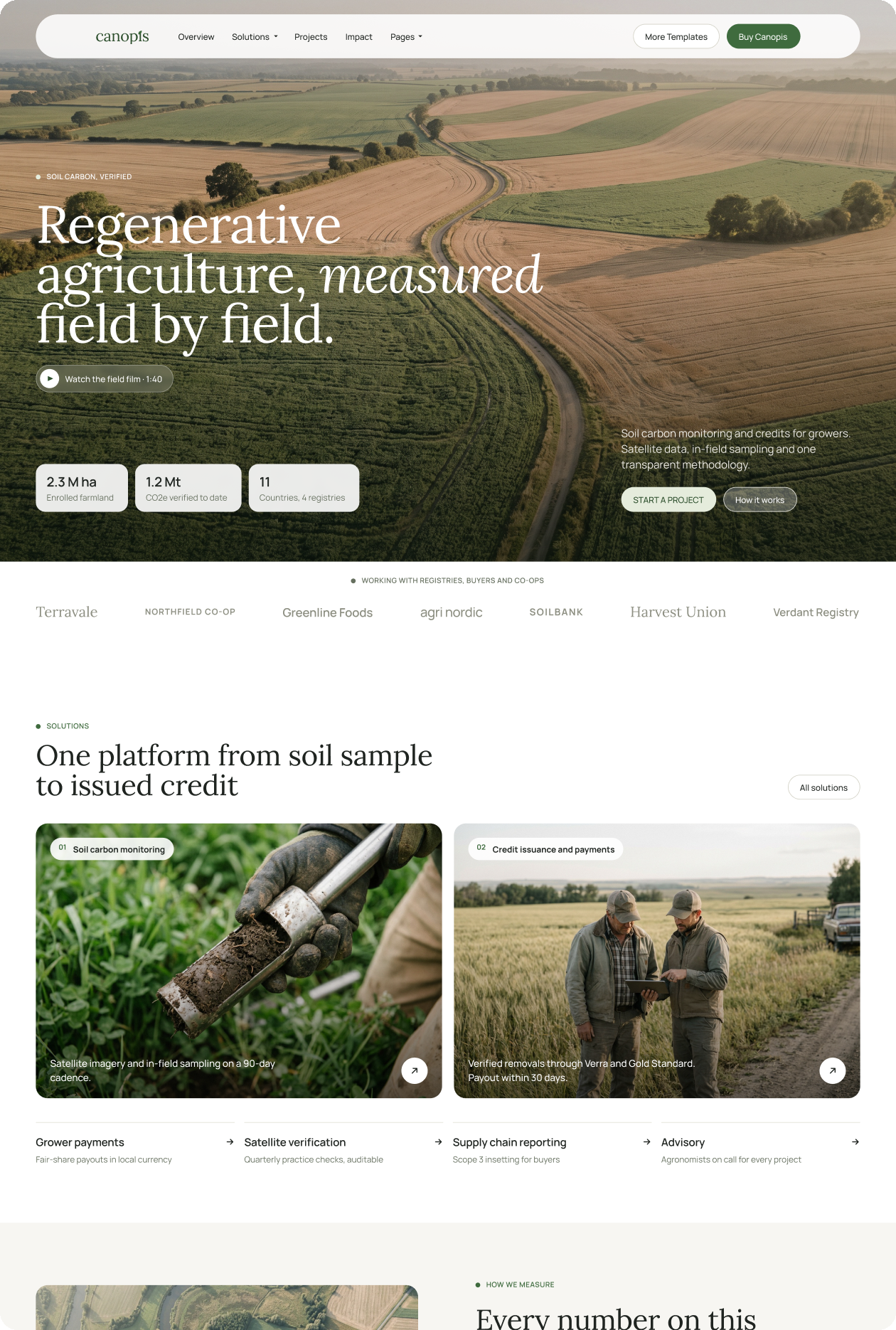
Best Webflow Templates for Climate Tech and Sustainability Companies

Climate tech VC funding crossed $100 billion in 2024 and has continued growing through 2025 and 2026, driven by policy tailwinds from the EU Green Deal, the US Inflation Reduction Act, and accelerating corporate net-zero commitments. That capital is funding thousands of startups - soil carbon platforms, green hydrogen producers, circular economy operators, sustainable food companies, climate data providers - and nearly all of them need a website that can do two things simultaneously: communicate scientific credibility to institutional investors and make the mission legible to the non-specialist audience increasingly driving purchasing decisions toward sustainable suppliers.
Canopis by Loonis is the only Webflow template built specifically for this brief. This post covers what a climate or sustainability company website actually needs - and why Canopis is the clearest answer to the query in 2026.
What does a climate tech or sustainability company website need to convert?
A climate tech or sustainability company website needs to resolve a specific tension that most startup templates do not address: it must communicate rigorous scientific or engineering credibility to investors and technical partners, while simultaneously making the mission and impact accessible to customers, policymakers, and the general public who increasingly factor sustainability into purchasing decisions. Generic SaaS templates optimise for trial signups. Generic corporate templates optimise for brand credibility. Climate tech companies need both, on the same site, for audiences with very different information needs.
The four structural requirements specific to climate and sustainability companies:
1. Impact metrics front and centre. The first thing an institutional investor or corporate sustainability buyer evaluates is whether the impact claims are specific and measurable. "We help companies reduce their carbon footprint" is not an impact metric. "1.2 million tonnes of CO2e avoided across 340 enterprise clients since 2022" is. Climate tech websites that lead with specific, verifiable impact numbers convert better with the audiences that matter most.
2. Science and methodology transparency. In climate tech, the methodology is the product. Whether it is a soil carbon measurement protocol, a green hydrogen production pathway, or a scope 3 emissions accounting model, buyers and investors need to evaluate the scientific basis before committing. A methodology or science page - not a PDF behind a contact form - signals that the company welcomes scrutiny. Canopis includes a dedicated Technology page built for exactly this: a place to publish your measurement protocol, production specs, or accounting model in full.
3. Solutions or projects CMS. Climate tech companies typically have multiple distinct solutions or project types. A solar development company has utility-scale projects, distributed energy projects, and community solar projects - each with different audiences, procurement processes, and proof points. A single services page cannot hold this complexity. Canopis provides CMS-powered Solutions and Projects sections - each solution or project carries its own case study references, technical specifications, and verified outcome data, including downloadable audit packs.
4. Visual register that signals credibility without greenwashing cliches. The wrong visual register for climate tech in 2026 is all-green stock photography with leaves, hands cupping soil, or sunsets over wind farms. The right register is precise, confident, and editorial - the visual language of serious science and engineering companies, not environmental marketing campaigns from 2015. Canopis was designed in exactly this direction: warm, photo-led, with a visual system built to communicate rigour, not aspiration.
Which Webflow template works best for climate tech companies in 2026?
The Webflow template market has very few options built specifically for climate tech and sustainability companies in 2026 - most founders use adapted SaaS or corporate templates and work around their structural limitations. The structural requirements - solutions CMS with project-level detail, methodology pages, impact metrics sections, a careers section for the talent-competitive climate sector - are rarely found together in a single template.
Canopis by Loonis is the exception.
Built for climate tech startups, carbon removal companies, soil carbon and carbon credit platforms, renewable energy startups, nature-based solution providers, and sustainability and ESG teams, Canopis ships with 27 pages and four CMS collections:
- Solutions - individual solution pages with full descriptions and linked projects
- Projects - verified results, deployment stories, and downloadable audit packs
- Insights - field notes, methodology updates, and research (the thought leadership engine that builds trust over time)
- Careers - the section most climate tech templates omit entirely
The page architecture covers every structural requirement: three homepage variants for testing your lead message, three Solutions landing pages, a dedicated Technology page for publishing methodology and specs, an Impact page with structured fields for results by region and year, a Partners page, a Request a Demo flow, three About variants, and a Contact page.
See the Canopis live preview to walk through the full structure.
When evaluating any Webflow template for a climate or sustainability company, the structural checklist is:
- CMS-powered solutions section with individual solution pages
- CMS projects section for documenting real-world deployments
- A science, methodology, or technology page (not just a features list)
- Impact metrics section with structured fields for quantified outcomes
- Team and advisors section with credential depth (academic and industry)
- Careers section - climate companies report competitive talent markets as a primary growth constraint
- Blog or insights CMS for thought leadership and policy commentary
- Investor relations or press section
Canopis hits every item on this list. Competing templates in this space - Greensign, Evergrid, Ecolite on the Webflow Marketplace - cover some of these requirements but lack the depth of the CMS architecture, the methodology page structure, or the editorial visual system that sets the right credibility register. They are not linked here.
What pages does a climate tech company website need?
A climate tech or sustainability company website needs eight pages at launch: a homepage with specific impact metrics visible above the fold, individual solution or technology pages, a projects or case studies section with deployment outcome data, a science or methodology page, a team and advisors page with academic and industry credentials, a careers page, an insights blog, and a contact or partnership inquiry page. The science page and the careers page are the two most commonly omitted - both are significant for the specific audiences a climate company needs to reach.
The science or methodology page is the first page institutional investors and technical partners navigate to after the homepage. It is where the company explains how the underlying science or technology works, what makes their approach defensible against alternatives, and what the verification or validation process looks like. Companies that publish this information attract better-informed first conversations than those that gate it behind a demo request.
The careers page matters because climate companies compete for talent against traditional energy companies and well-funded tech companies, on a mission story that often has to substitute for higher cash compensation in early stages. A careers page that makes the mission concrete, names the team the candidate would join, and is specific about what the company is building over the next 18 months converts better than a generic jobs board embed.
Canopis includes dedicated pages for all eight launch requirements - plus the Impact page (results by region and year), the Partners page, and the Request a Demo flow - within its 27-page architecture. The Figma source file is included with the $129 Webflow + Figma bundle.
How should a climate tech website communicate impact without greenwashing?
The credibility gap in climate tech marketing in 2026 is between vague aspiration and specific, verifiable impact claims - and the regulatory context has now hardened around it. Websites that state "we are committed to a net-zero future" without quantified evidence are no longer just unconvincing to sophisticated buyers; in key markets they may now be non-compliant.
EU Directive 2024/825 (Empowering Consumers Directive) took effect on 27 September 2026 across EU member states. It prohibits generic environmental claims - "eco-friendly," "sustainable," "green" - unless backed by specific, recognised scientific evidence. It bans carbon-neutrality claims based solely on purchased carbon offsets. It requires that sustainability labels come from officially approved certification schemes. Future commitments like net-zero targets need a documented, independently verified transition plan with interim milestones. (Source: Dcycle, EU Green Claims Directive 2026)
In the US, the FTC Green Guides (last updated 2012) remain in effect as guidance on environmental marketing under Section 5 of the FTC Act. The FTC opened a comprehensive review in 2022 covering terms like "net zero," "carbon neutral," and "sustainable" - that review was ongoing as of late 2026. The Guides require that environmental claims be truthful, backed by reliable evidence before being made, and qualified so consumers understand their scope and limits. (Source: Net Zero Compare, FTC Green Guides)
Note: this is factual context, not legal advice. Consult a qualified attorney for compliance questions specific to your business.
The framework for impact communication that builds credibility in both markets:
Quantify, not qualify. "Significant carbon reduction" becomes "2.3 million tonnes CO2e removed, verified by Gold Standard." Specific numbers are harder to achieve but impossible to dismiss.
Show the verification layer. Third-party verification (Gold Standard, Verra VCS, SBTi commitment, B Corp certification, ISO certifications) belongs adjacent to the impact claims it supports - not in the footer.
Separate aspiration from delivery. Companies that are honest about what they have achieved versus what they are working toward build more credibility than those presenting future goals in the present tense. "We have removed 1.2 million tonnes to date" alongside "Our 2030 target is 50 million tonnes" is more credible than presenting the 2030 target as current impact.
Use editorial photography, not stock. Real images of the actual technology, team, and projects - even at lower production quality - outperform stock photography of generic green scenes for building credibility with sophisticated audiences.
Canopis's Impact page is structured specifically for this: fields for results by region and year, project-level verified outcomes in the Projects CMS, and methodology documentation on the Technology page. The architecture makes it straightforward to publish evidence for every claim.
How much does a climate tech website cost to build in 2026?
A professional climate tech or sustainability company website on a Webflow template costs $129 (Canopis, DIY) to $1,879 total in year one with done-for-you configuration by Loonis. Custom climate tech websites from specialist agencies typically run $15,000-$60,000 and take 3-6 months. For most pre-Series A and Series A climate companies, the template path delivers the structural foundation needed for investor and partner credibility at a fraction of the custom build cost.
For a climate company raising a $5M+ Series A, a $1,879 website that presents the science, team, and impact credibly is one of the highest-leverage pre-round investments available.
See Canopis - $129 Webflow + Figma
Want it launched for you? Our team customizes Canopis in 5 days. See Loonis customization services
In summary
- Climate tech VC funding crossed $100B and has continued growing. The websites that win investor and partner trust lead with specific, verifiable impact metrics - not aspirational statements.
- Four structural requirements distinguish a climate tech site: impact metrics front and centre, science and methodology transparency, a CMS solutions and projects section, and a visual register that signals rigour rather than greenwashing aesthetics.
- Eight pages at launch: homepage with impact data, individual solution pages, projects CMS, science or methodology page, team with credential depth, careers, insights blog, and partnership inquiry.
- The credibility gap in climate marketing is specificity. EU Directive 2024/825 (in force from 27 Sept 2026) bans generic green claims and offset-only neutrality claims. FTC Green Guides require all environmental claims to be substantiated. Quantified, verified, time-bounded impact claims convert institutional buyers and investors. Vague commitments do not.
- Canopis by Loonis is purpose-built for climate tech and sustainability companies: 27 pages, Solutions, Projects, Insights and Careers CMS, Technology and Impact pages, warm editorial visual direction. $129 Webflow + Figma. See the live preview.