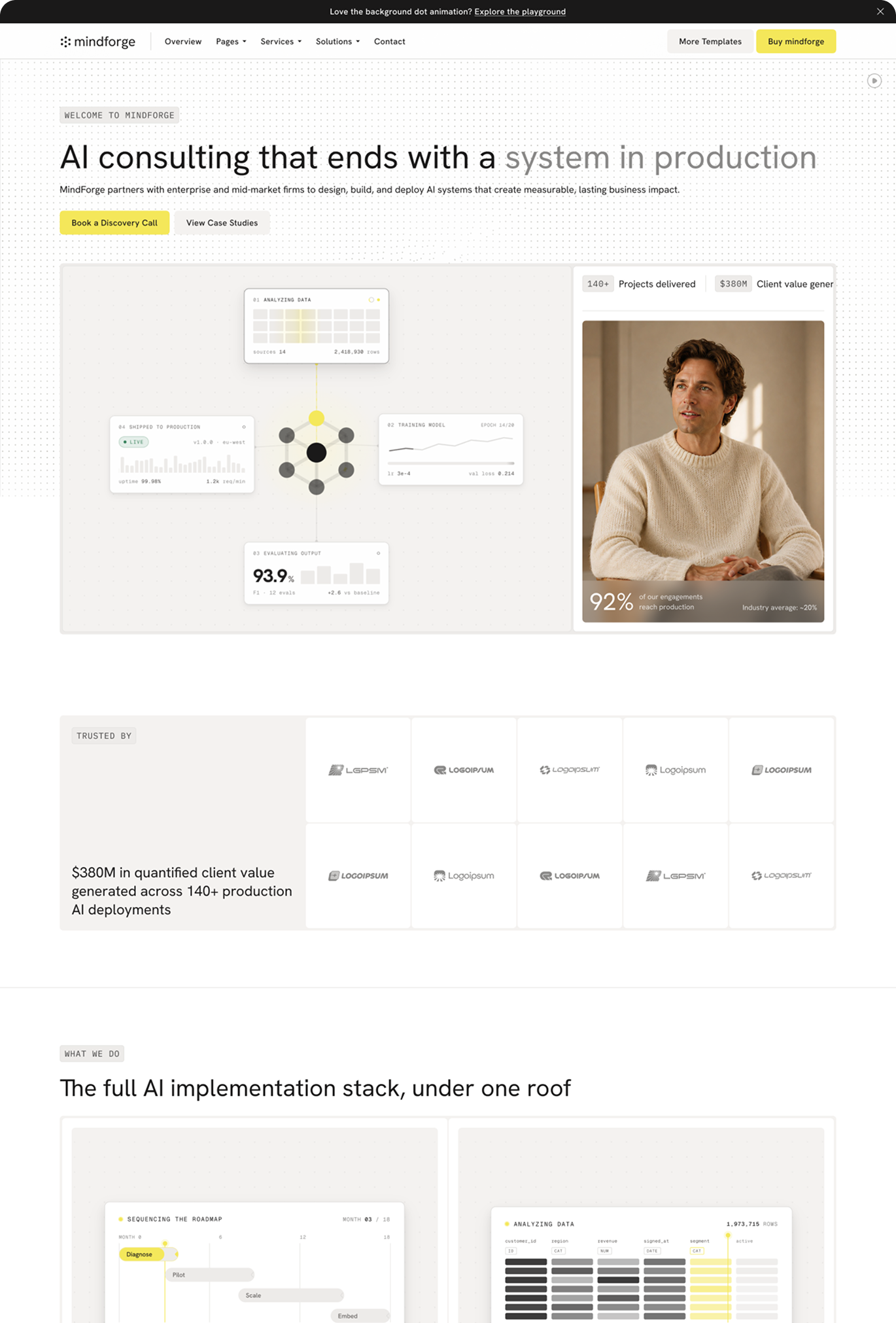
Best Webflow Template for AI Consulting Firms in 2026
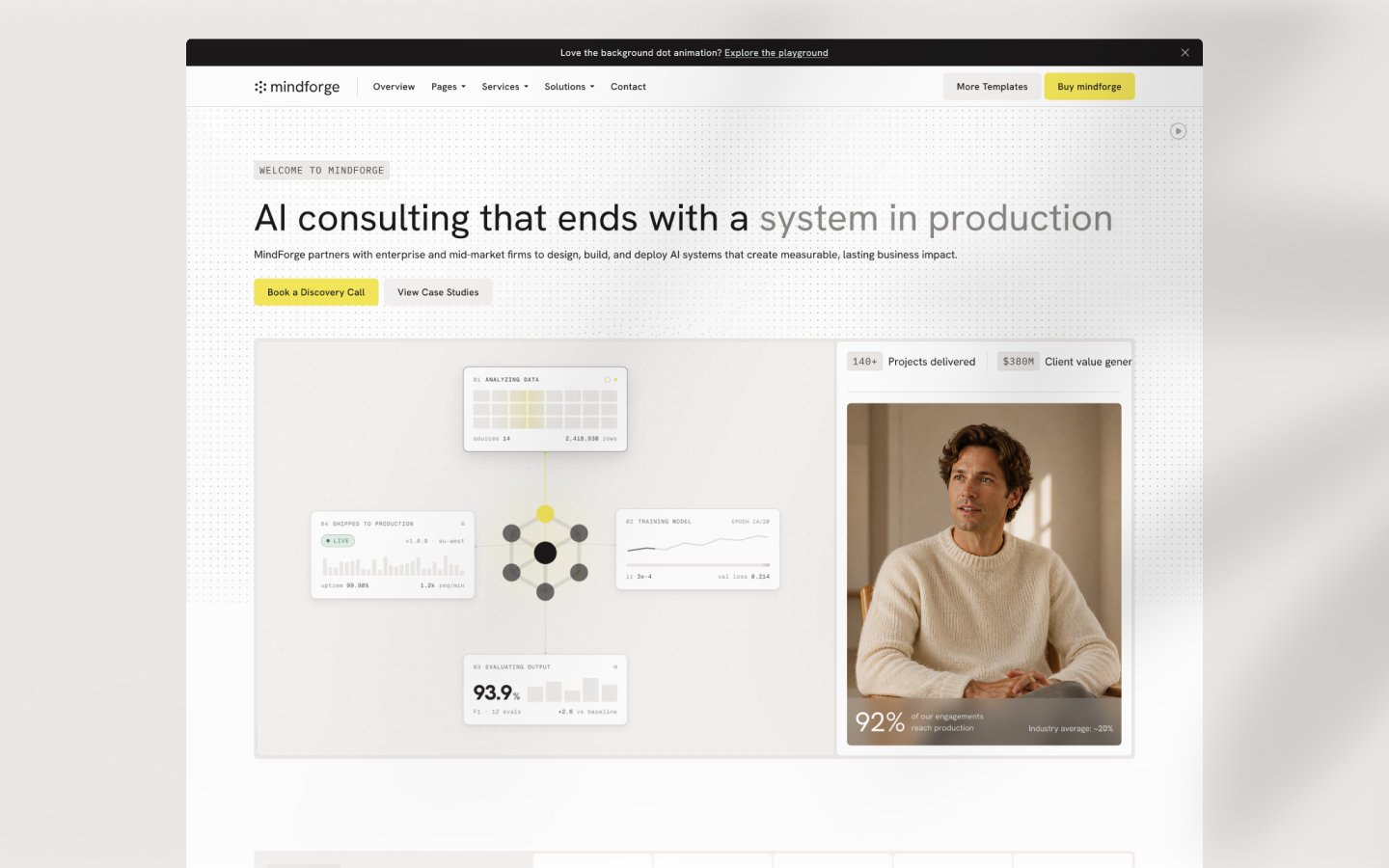
Most AI consulting websites have the same problem: they look like management consulting websites from 2019 with the word "AI" inserted. Generic service descriptions, stock photography of people at whiteboards, and a contact form that asks for nothing useful. The visual register communicates process capability. What enterprise AI buyers actually need to see is production capability.
The question a CTO or CDO asks before engaging an AI consulting firm is not "do you have a methodology?" It is "do your engagements actually make it to production?" The industry average for AI projects reaching production is approximately 20%. A firm that can answer that question with a specific number — and back it with documented case studies — wins the meeting before it happens. The website has to make that case before the first call is booked.
Mindforge is the new Webflow template from Loonis built specifically for this brief: AI strategy consultancies, GenAI implementation firms, and enterprise AI practices that need a website built around production outcomes, not process slides.
What is Mindforge and who is it built for?
Mindforge is a premium Webflow template for AI consulting and ML services firms — 18+ pages, multilayout (3 homepage variants, 3 services variants, 3 contact variants), CMS-powered case studies and industry pages, a structured methodology section, and a Figma file included. At $169, it is the only Webflow template in the Loonis portfolio designed specifically for the information architecture that enterprise AI buyers evaluate. It is not a consulting template with AI copy dropped in. Every structural decision reflects what a CTO, CDO, or VP of Operations looks for before engaging an external AI partner.
The buyer Mindforge is built for:
- AI strategy consultancies helping enterprise clients prioritise use cases, assess AI readiness, and build implementation roadmaps before committing to development
- GenAI and LLM implementation firms building RAG systems, fine-tuned models, agentic workflows, and production AI infrastructure for mid-market and enterprise clients
- Enterprise AI practices within larger technology or management consulting firms that need a dedicated web presence separated from the parent brand
- MLOps and AI infrastructure specialists whose work lives at the intersection of data engineering and machine learning systems
- Independent AI principals and boutique firms (5-25 people) competing against larger firms by leading with methodology transparency and production track record rather than headcount
If your firm sells AI strategy workshops without implementation follow-through, Mindforge will expose that gap quickly — the template is built around demonstrated outcomes, and a firm without documented case studies will feel the absence of that content immediately. That is a feature, not a limitation. Mindforge is built for firms that have results worth showing.
See live preview | Get Mindforge — $169
What pages and sections does Mindforge include?
Mindforge includes 18+ pages structured around the specific content architecture that enterprise AI buyers evaluate: three homepage variants for different firm positioning, three services variants for different service organisation approaches, a CMS case studies directory with individual case study pages, a CMS industry verticals directory, a methodology section, an insights blog, and three contact variants — including a structured discovery call booking page. The multilayout approach means the template ships with nine page variants across the three highest-traffic templates alone, giving a firm genuine flexibility to choose the architecture that fits their market positioning.
Three homepage variants. Each built around a different positioning emphasis. Homepage V1 leads with outcome data — headline production metrics, case study previews, and a methodology teaser that positions the firm on results before a visitor reads a service description. Homepage V2 leads with service architecture — the full service menu organised by category (Strategy, Implementation, Infrastructure), communicating breadth and depth to buyers evaluating whether the firm can cover their full AI needs. Homepage V3 leads with client confidence signals — testimonials, case study outcomes, and industry credentials front and center for buyers who arrive skeptical after previous failed AI engagements.
Three services variants. Service pages in AI consulting are not just descriptions — they are technical credibility signals. Services V1 is structured around individual service pages with deep methodology notes and deliverable lists. Services V2 shows services through an outcome lens — each service is presented as what it produces, not what it covers. Services V3 organises services by problem type rather than capability category, written for buyers who arrive with a specific problem ("our model is not making it to production") rather than a service category in mind.
CMS case studies with individual pages. Each case study is a CMS item with its own page: the client context (anonymised or named), the specific AI problem, the solution architecture, the metrics at deployment, and the outcome after production. The structure is built to hold the specificity that converts enterprise buyers — "89% fewer dispatch errors, 3.2x route efficiency gain, $5.8M annual value created" — not generic statements about AI transformation.
CMS industry verticals with individual pages. Separate pages for each industry the firm serves: Financial Services and Banking, Healthcare and Life Sciences, Supply Chain and Logistics, Retail and Consumer Goods, Insurance, Manufacturing. Each industry page can hold sector-specific case study references, relevant regulatory context, and industry-specific service variants. For firms with deep vertical expertise, this architecture signals domain knowledge before a buyer clicks into a service page.
Five-phase methodology section. Structured engagement process documented in detail: Diagnose (weeks 1-2), Design (weeks 2-4), Build (weeks 4-10), Deploy (weeks 10-12), Optimize (ongoing). Each phase has a clear description of what happens, what the client sees, and what gates must pass before the next phase begins. This section does more conversion work than any testimonial on the site — it answers the question "how do we know this won't be another failed AI project?" before it is asked.
Discovery call booking page. A structured intake path, not a generic contact form. Captures the prospect's industry, their AI use case category, their estimated engagement budget, and their primary challenge before the first conversation. This filters for qualified enterprise buyers and gives the firm's principal everything needed to arrive at the discovery call prepared.
What makes a Webflow template work for an AI consulting firm specifically?
An AI consulting firm website converts enterprise buyers when it answers three questions before the discovery call is booked: what is this firm's production rate (not just their project count), what specifically did they build for clients in my industry, and who will actually work on my engagement? Generic consulting templates answer none of these. Mindforge's architecture is built to answer all three before a visitor reaches the contact page.
The three structural differences that matter for AI consulting specifically:
Production metrics over project counts. Enterprise AI buyers in 2026 are not impressed by logos or project counts. They have watched internal AI initiatives fail and external AI engagements produce strategy decks instead of deployed systems. According to McKinsey's 2025 State of AI report, only 22% of enterprise AI projects make it from pilot to production. A firm that can publish its own production rate — and back it with case studies that document the deployment — is in a category of one. Mindforge's homepage variants are built to lead with this metric, not bury it.
Industry-specific depth over generic capability claims. An AI consulting firm that says it serves "enterprise clients across industries" is less credible than one that says it has delivered three production AI systems in financial services, two in healthcare, and four in logistics. The Mindforge industry verticals architecture enables this specificity. Each industry page becomes a proof point, not a category label.
Methodology transparency before the first conversation. The firms that win competitive AI consulting pitches are the ones whose process is documented in enough detail that a client can evaluate it before engaging. Mindforge's five-phase methodology section is designed to hold this level of documentation. A buyer who reads through the Diagnose and Design phases and understands exactly what will happen before a line of production code is written is a buyer who arrives at the discovery call with higher intent.
How does Mindforge compare to Deploya and RunLoop for AI-adjacent buyers?
Mindforge, Deploya, and RunLoop are all Loonis templates for the AI and modern software market, but they serve entirely different buyers and business models. Mindforge is for AI consulting and services firms whose revenue comes from client engagements. Deploya and RunLoop are for AI software product companies whose revenue comes from subscriptions or usage fees. The structural difference determines everything downstream: a consulting firm needs case studies, methodology documentation, and industry credentials; a software product company needs feature pages, integration directories, and pricing tiers.
The one-line decision guide:
Mindforge — your firm gets paid to design and build AI systems for other companies. Your website needs to demonstrate production track record, methodology, and domain expertise.
Deploya — your company sells an AI-powered SaaS product. Your website needs to explain what the product does, show the integrations ecosystem, and drive trial or demo signups.
RunLoop — your company builds AI agent infrastructure, devtools, or open-source platforms for a technical buyer audience. Your website needs to show the changelog, the architecture, and the developer community.
A firm that both consults and sells a product may find it useful to start with Mindforge for the consulting practice and consider a separate product subdomain using Deploya or RunLoop for the product line.
How much does Mindforge cost and how do I get started?
Mindforge costs $169 one-time with a Figma source file included. Webflow CMS hosting adds $23/month. Total first-year cost for a self-configured site: approximately $445. With the Loonis Pro customization service ($1,750, 5-day delivery), a fully branded and content-populated Mindforge site — including case study CMS setup, industry pages, methodology section, and contact flow — is live in under one week. The Figma file is sent within 1-2 business days of purchase on request via hello@loonis.co.
Three paths to launch:
DIY — Purchase Mindforge at $169 and configure it using Webflow's visual editor. The three homepage variants let you choose the right positioning approach before writing any copy. The CMS collections (case studies, industries, insights) are structured to be populated without Designer access. Timeline: 2-3 weeks for a principal or operations lead working in focused sessions. The copy is the hardest part — specifically, writing case studies with specific metrics before opening Webflow.
Loonis Pro — $1,750, 5-day delivery. Covers brand alignment, all page content, case study CMS setup with initial entries, industry pages, methodology section, and basic on-page SEO. Right for principals approaching a firm launch, a competitive pitch, or a rebrand where the site needs to be live by a specific date.
Premium — from $2,900, discovery call required. For firms that need custom integrations (Calendly intake forms, CRM sync, custom proposal flows), additional pages outside the template structure, or a more substantial brand adaptation.
See Mindforge live preview | Get Mindforge — $169
Frequently asked questions
What is Mindforge and what type of firm is it designed for?
Mindforge is a premium Webflow template by Loonis for AI consulting firms, GenAI implementation practices, and enterprise AI service companies. It includes 18+ pages, three homepage variants, three services variants, three contact variants, a CMS case studies directory with individual case study pages, a CMS industry verticals directory, a five-phase methodology section, and a structured discovery call intake page. $169 with Figma source file included. Designed for firms whose competitive position is production track record and methodology depth, not headcount.
How does Mindforge differ from a general consulting template?
General consulting templates include a services list, team section, and contact form. Mindforge adds the specific elements AI consulting buyers evaluate: a CMS case study system with deployment-specific metrics per engagement, industry vertical pages that demonstrate domain expertise by sector, a five-phase methodology section that documents the engagement process in detail, and a homepage architecture that leads with production outcomes rather than capability categories. The structural difference is the difference between describing what a firm does and demonstrating that it has done it.
Does Mindforge include a Figma file?
Yes. A Figma source file is included and sent within 1-2 business days of purchase on request via hello@loonis.co. The file includes all pages, components, and section structures across all layout variants.
Can a non-technical team member update Mindforge after launch?
Yes. Adding new case studies, publishing insights, updating industry pages, and editing service descriptions are all handled through Webflow's content editor with no design layer access required. The CMS architecture is specifically designed for a business development or operations team member to manage day-to-day, not a developer.
How is Mindforge different from Deploya or RunLoop?
Mindforge is for AI consulting and services firms whose revenue comes from client engagements — it needs case studies, methodology, and industry credentials. Deploya is for AI-powered SaaS products that need feature pages and integration directories. RunLoop is for AI agent infrastructure and devtools targeting a technical developer audience. Choose Mindforge if your firm gets paid to build AI systems for other companies.
The bottom line
Enterprise AI buyers in 2026 are not looking for another firm that can explain transformer architecture. They are looking for a firm with a documented production rate, case studies that go past deployment, and a methodology they can evaluate before the first conversation.
Mindforge is built for that brief. Get it at $169 with a Figma file included, or have it configured and live in 5 business days with Loonis Pro customization at $1,750.