How to Create a Startup Website in 2026

Most startup founders spend months on their product and days on their website. Then they wonder why they're not getting inbound leads. The website is not an afterthought — it is the first thing a potential customer, investor, or press contact sees, and it either earns the next conversation or ends it. The good news: building a professional startup website in 2026 no longer requires a developer, an agency, or six weeks of calendar time.
A poorly designed website loses visitors in under 50 milliseconds — the time it takes for a first impression to form (CXL Institute). Meanwhile, custom web development costs $10,000–$50,000+ and takes 8–20 weeks. In 2026, that gap has closed. Premium Webflow templates give non-technical founders a professional, fully responsive site for $169, live in days. This guide covers exactly how to do it.
What do you actually need before building your startup website?
Before touching any website builder, a startup founder needs three things decided: a clear value proposition that fits in one sentence, the five core pages the site must include, and a realistic launch timeline with a hard deadline. Most website projects stall not because of technical difficulty but because these three decisions were never made upfront.
From our experience at Loonis working with startup founders across 6 verticals, the most common mistake is starting with design before locking down the message. You can spend two weeks choosing fonts and colours and still have no idea what your homepage should say. Content decisions come first. Design follows.
Here is what to settle before you open any tool:
- Your one-sentence value proposition. Who is the customer, what problem do you solve, and what is the specific outcome they get? If you cannot write this in one sentence without jargon, the website cannot communicate it either.
- The five pages you actually need. For most early-stage startups: homepage, features or services page, pricing page, about or team page, and contact. Everything else is scope creep for launch.
- A hard launch deadline. Not "when it's ready." A specific date — ideally 2–3 weeks out — that creates accountability and prevents endless iteration on things that don't affect whether the site converts.
Which platform should a startup use to build its website in 2026?
For most non-technical startup founders in 2026, the right website platform is Webflow — specifically a premium industry-specific Webflow template rather than a blank canvas. Webflow gives you full design control and a clean CMS without requiring code, while a purpose-built template gives you the right page architecture for your business type from day one instead of forcing you to build it from scratch.
Wix and Squarespace are faster to start but create long-term problems. Both lock you into their proprietary infrastructure, making migration painful. Founders who built on them early and later needed to move describe it as one of their worst technical decisions. For a startup that expects to scale, outgrow, or fundraise, these platforms are the wrong foundation.
WordPress gives you full ownership and the largest plugin ecosystem, but requires hosting setup, security management, and plugin maintenance that adds ongoing technical overhead — the opposite of what a non-technical founder needs.
Webflow with a template is the sweet spot: professionally designed, fully responsive, clean semantic HTML for SEO, hosted infrastructure, CMS for blog and content, and full editing control through a visual designer. 82% of business users report higher ROI from no-code tools compared to traditional development (YAAM Web Solutions, 2026). Custom web development costs $5,000–$50,000+ as a one-time project. A premium Webflow template costs $169.
Which Webflow template is right for a startup website?
The right Webflow template depends on your startup's stage and target buyer. A pre-product landing page needs a different architecture than a multi-product B2B platform. A developer-tool startup needs a different visual register than a consumer fintech app. Choosing the wrong template means spending weeks fighting the structure rather than populating it with content.
Here is the decision framework by startup type:
Early-stage, pre-seed to Series A — GoLive
Built for product launches and early-stage startups that need to look credible fast. Clean homepage, feature sections with space for product screenshots, a pricing section, and a blog CMS.
Growing B2B SaaS, multiple use cases — Cloudis
23 pages covering the full B2B software product site: homepage, features, pricing, integrations, blog, about, and team. For startups that have moved beyond the MVP stage and need depth.
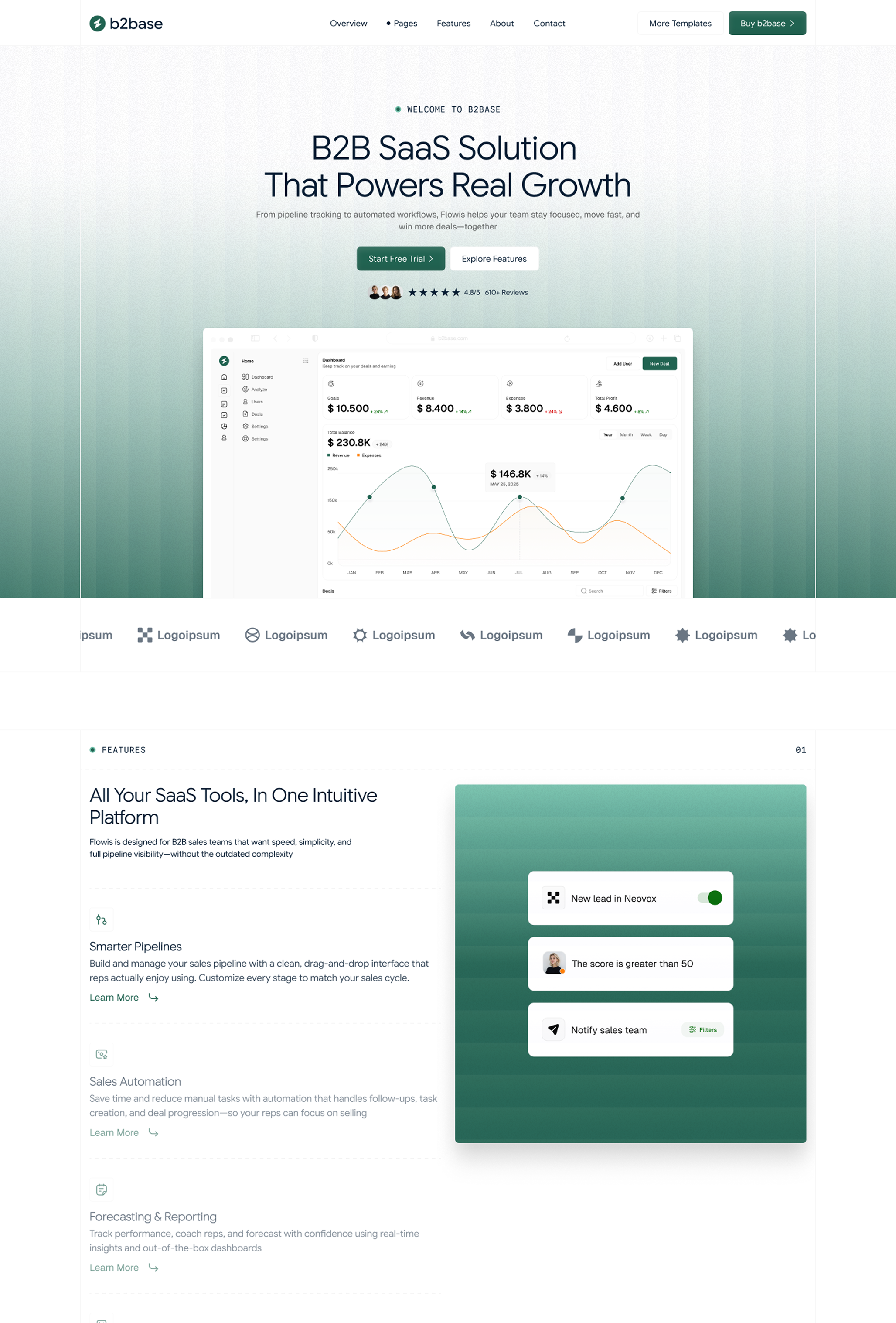
Enterprise-positioned software — Flowis
26 pages for products selling into mid-market or enterprise buyers who self-serve deep into the site before engaging with sales.
AI startups and integration-led products — Deploya
25 pages with a CMS-powered integrations directory, e-commerce capability, and a design register built for the AI and modern software product vertical. The only Loonis template with a native integrations ecosystem architecture.
Developer tools and technical products — Lumis
Dark-mode SaaS template for developer tools, API platforms, cybersecurity software, and AI/ML companies.
IT agencies and digital service firms — Structa
20 pages for IT consultancies, managed service providers, and digital transformation agencies.
Not sure which fits? Take the Loonis Launch Plan Builder quiz — it recommends the right template in under 3 minutes. Or read the full guide to choosing a Webflow template.
What pages does a startup website need?
A startup website needs exactly five pages at launch: homepage, features or services page, pricing page, about or team page, and contact page. Everything else can be added after launch. Launching with five strong pages beats launching with fifteen mediocre ones.
Here is what each page must accomplish:
Homepage — Answer the three questions a first-time visitor asks within 5 seconds: what do you do, who is it for, and what should I do next? The headline is your one-sentence value proposition. Social proof belongs above the fold, not the bottom.
Features or services page — Not a feature list. A benefits-led explanation of what your product or service does, organised around the problems your buyer has rather than the capabilities you built. Each section should answer: "so what does this mean for me?"
Pricing page — Hiding pricing is one of the fastest ways to lose B2B prospects. Show tiers clearly, list what is included in each, and answer the question every buyer has before they'll book a demo.
About or team page — In the early stages, the team is the product. Investors, customers, and press all want to know who is behind the company. Photos, short bios, and any credentials that build credibility for your specific market.
Contact page — Name, email, a simple form, and response time expectation. The contact page is often the highest-intent page on a startup site — do not bury it or make it hard to find.
One more essential element: a CMS blog from day one. Content marketing is the primary organic acquisition channel for most startups without paid acquisition budgets. Setting up the blog architecture at launch rather than retrofitting it later saves significant time. All Loonis SaaS templates include a full CMS blog as part of the default structure.
How long does it take to build a startup website without a developer?
With a Webflow template and DIY content setup, a non-technical founder can have a startup website live in 1–2 weeks. With Loonis Pro customisation, a fully configured, branded, content-populated site is delivered in 5 business days. The most common delay is not technical — it is content. Founders underestimate how long it takes to write a homepage headline that actually works, source product screenshots, and collect team photos.
Timeline comparison:
For a startup founder, the Pro customisation path deserves serious consideration. At $1,750 on top of the $169 template, it delivers a professionally configured site in 5 business days — including branding alignment, all page content, CMS setup, and basic on-page SEO. That is five fewer weeks your founding team spends on website decisions instead of building the product.
What are the most common startup website mistakes to avoid?
The five most common mistakes non-technical startup founders make with their website are: launching too late, leading with features instead of outcomes, hiding the pricing, skipping the blog CMS setup, and treating mobile as an afterthought. Every one of these is fixable before launch if you know to look for them.
Launching too late. The perfect website does not exist. A live five-page site with a clear value proposition earns more than a polished twelve-page site still in drafts three months from now. Launch with what you have. Iterate based on what visitors actually do.
Leading with features instead of outcomes. "AI-powered scheduling automation" is a feature. "Never miss a client meeting again" is an outcome. Buyers respond to outcomes. Write every headline in terms of what the customer gets, not what the product does.
Hiding the pricing. A pricing page that says "contact us for pricing" sends B2B prospects directly to a competitor whose site answers the question. Show your pricing. If it is complex, show at least a range and what drives the variation.
Skipping the blog CMS. Setting up a blog architecture after launch when your site is already full of content is painful. Add it at the start even if you are not publishing immediately.
Treating mobile as an afterthought. Over 82% of business users now use mobile devices for initial research before converting on desktop (YAAM Web Solutions, 2026). Always check the mobile preview before publishing.
Frequently asked questions
Can I build a startup website without any coding knowledge?
Yes. Webflow is a fully visual editor — no code required for standard editing, content updates, CMS management, or publishing. A Webflow template like GoLive or Cloudis comes with all pages and CMS collections pre-built. Change colours, fonts, images, text, and sections through point-and-click. Code is only needed for highly specific custom integrations that fall outside Webflow's native capabilities.
How much does a startup website cost in 2026?
A Webflow template costs $49–$169 as a one-time purchase. Webflow CMS hosting runs $23/month. Total first-year cost for DIY: approximately $350–$450. With Loonis Pro customisation ($1,750), total first-year cost is under $2,000. Custom agency builds start at $10,000 and go past $50,000. For most early-stage startups, the template-plus-customisation path delivers equivalent credibility at a fraction of the cost and time.
How many pages does a startup website need to launch?
Five: homepage, features or services page, pricing page, about or team page, and contact page. A CMS blog should be set up at launch even if you are not publishing immediately. Everything else can be added after you have validated that the site is converting visitors into leads.
What is the difference between Webflow and WordPress for startups?
Webflow is a fully managed, hosted platform — no server setup, no plugin management, no security updates required. Full design control through a visual editor, clean semantic HTML, and a CMS for blog content. WordPress gives you maximum flexibility and the largest plugin ecosystem but requires technical setup and ongoing maintenance. For a non-technical founder launching fast, Webflow is the better starting point.
Should I build my own startup website or hire someone to do it?
For most early-stage startups, building with a Webflow template is the right call — it keeps you close to the messaging and lets you iterate quickly. If you are time-constrained or approaching a fundraise or press moment, the Loonis Pro customisation service delivers a fully configured, branded site in 5 business days for $1,750. Hire a freelance developer only when you need custom functionality a template cannot accommodate.
The bottom line
Building a startup website in 2026 does not require a developer, an agency, or a six-figure budget. It requires a clear value proposition, five core pages, and the right template for your stage and audience.
If you know your startup type, the Loonis SaaS template range covers early-stage, growth-stage, enterprise, developer-facing, and IT service company needs. If you want the site live and configured in 5 business days without handling setup yourself, the Loonis Pro customisation service is the fastest credible path from zero to launched.