The 12-Point AEO Framework Loonis Uses to Get Webflow Sites Cited by AI
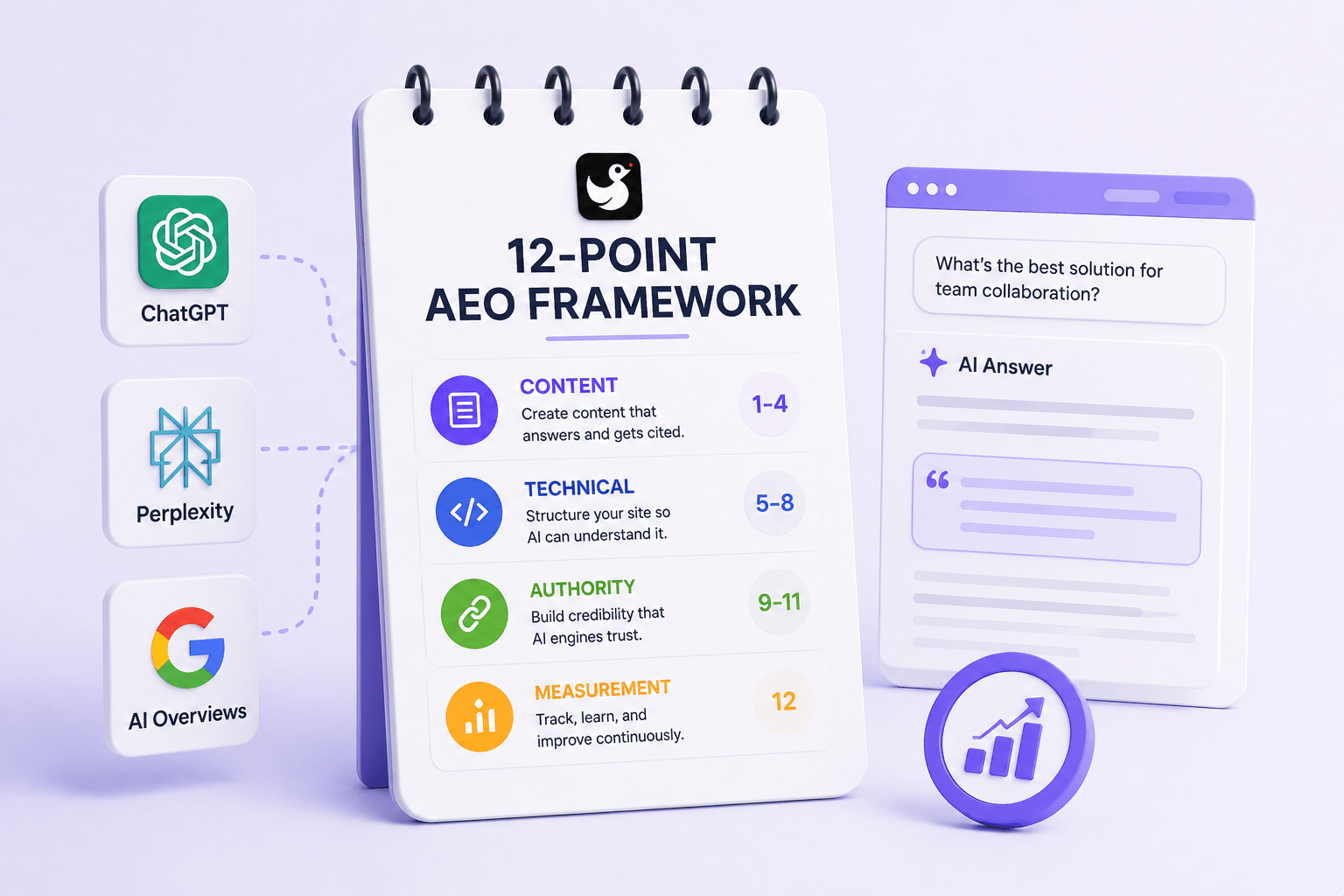
Most AEO advice is generic. Question-based headings, answer capsules, schema markup — the list of tactics is widely published, and most of it is correct. What is rarely published is the specific implementation sequence, the priority ranking, and the decisions that determine whether a Webflow site moves from invisible to cited in ChatGPT, Perplexity, and Google AI Overviews within 8-12 weeks.
This document is the internal framework Loonis uses when working on AEO for Growth Plans clients and for loonis.co itself. It is organised as a 12-point checklist across four domains: Content, Technical, Authority, and Measurement. Each point includes the specific signal it sends, the implementation method in Webflow, and the priority level. We publish it here because the framework only works if you understand the reasoning, not just the rules.
What is the Loonis AEO framework and what does it cover?
The Loonis AEO framework is a 12-point implementation checklist across Content, Technical, Authority, and Measurement that gets Webflow sites cited by AI answer engines within 8–12 weeks when applied systematically. It is built on the Webflow AEO Maturity Model (4 categories × 5 levels, published April 2026), the GEO research from Princeton's Aggarwal et al. (2023), and Loonis's own citation tracking data. The framework is not a monitoring checklist — it is an execution checklist. Each point produces a measurable output.
The context for why this framework exists: 95% of B2B buyers plan to use generative AI in their buying process in 2026 (Forrester), and 93% of marketing leaders say AEO will be critical to their company's success — yet only 25% of practitioners fully understand what to implement (Webflow AEO Survey, 2026). The implementation gap is the opportunity. Brands that execute systematically earn citation share before competitors catch up.
The 12 points below are ordered by domain, not by priority. Within each domain, points are listed from highest to lowest implementation impact.
Content domain: 4 points
The content domain covers the structural and editorial signals that determine whether AI engines extract and cite a page. All four content points must be in place on every priority page before the technical domain amplifies them. Content is the foundation — schema on a poorly structured page does not produce citations.
Point 1: Question-based H2 headings
Every H2 section heading must be phrased as a full question that a buyer would actually ask. Not "Our Services" or "Key Features" — "What services does a management consulting firm need on its website?" or "What features differentiate a premium Webflow template from a free one?"
Why this works: AI engines match user queries against page headings. A heading phrased as a question is an exact structural match for the queries AI engines are answering. Pages with question-based H2s are cited at a significantly higher rate than pages with keyword-fragment headings (Aggarwal et al., Princeton GEO Study, 2023).
Implementation in Webflow: In the CMS rich text editor, use Heading 2 (H2) for all major section headings. Verify the heading level in the Designer using the element settings panel — do not use H1 for anything other than the page title. Check all H2s end with a question mark or begin with a question word (What, How, Which, Why, When, Is, Are, Do, Does, Can, Should).
Loonis standard: Every blog post and key landing page we produce uses question-based H2s. This single change produced the most consistent improvement in Perplexity citation rates across the sites we track.
Point 2: Answer capsules
The first paragraph under every H2 must answer the section question in 40–60 words, written as a self-contained statement that makes complete sense extracted from the page. This is the answer capsule. It is the part AI engines quote.
Why this works: 44% of ChatGPT citations come from the first 30% of a page (AirOps, 2026). More specifically, AI engines extract the paragraph immediately following a section heading when that paragraph directly answers the heading question. A paragraph that opens with "Great question — there are many factors to consider..." is never cited. A paragraph that opens with "The three key factors are X, Y, and Z, because..." is cited frequently.
Implementation in Webflow: Write the answer capsule before opening the CMS editor. The discipline of writing the 40–60 word answer in a blank document first — before formatting, before context, before caveats — produces better capsules than editing directly in Webflow's rich text field.
Loonis standard: Every H2 in every blog post we produce opens with a bolded answer capsule. The bold formatting signals the extractable unit to both human readers and AI engines.
Point 3: Named statistics with source attribution
Every data claim must include a named source and, where possible, a year. Not "studies show" or "research suggests" — "According to Forrester (2025), 95% of B2B buyers..." or "Gartner projects a 25% decline in traditional search traffic by 2026."
Why this works: Content with attributed statistics is cited 115% more than content with unsourced claims, according to the Princeton GEO study (Aggarwal et al., 2023). AI engines use source attribution as a quality signal — it makes the content more trustworthy to extract and attribute.
Implementation: Minimum three named external statistics per priority page. Statistics should come from research firms (Forrester, Gartner, McKinsey), academic papers (Princeton, Stanford), or named industry reports — not anonymous blog posts or "according to experts." Include the source name and year inline in the sentence, not only in a footnote.
Loonis standard: Every Growth Plans content piece includes a minimum of three named citations before publication.
Point 4: Content freshness cadence
Every priority page must show a visible "Last Updated" date and must be updated at least every 8–12 weeks. The schema dateModified field must reflect the actual update date, not the original publish date.
Why this works: 95% of ChatGPT citations point to pages updated within the last 10 months (AirOps, 2026). A well-structured page that has not been updated in 14 months drops out of the AI citation pool regardless of its schema and content quality. Freshness is not optional — it is a recurring maintenance requirement.
Implementation in Webflow: The "Last Updated" date is a visible text field in the blog CMS. The dateModified field in the JSON-LD schema must be manually updated each time the page is refreshed. Set a calendar reminder for every priority page at 10 weeks from the last update. The minimum viable refresh is adding one new statistic, updating one price reference, and updating the dateModified timestamp.
Loonis standard: All published blog posts on loonis.co have a "Last Updated" timestamp. A monthly check flags any post where dateModified is more than 90 days old.
Technical domain: 4 points
The technical domain covers the machine-readable signals that help AI crawlers find, understand, and trust a page. Technical signals amplify content quality — they do not substitute for it. A page with perfect schema and no answer capsules will not be cited. A page with strong answer capsules and complete schema will be cited consistently.
Point 5: Article + FAQPage JSON-LD schema
Every blog post and key landing page must have a single <script type="application/ld+json"> block in the page <head> containing both Article schema (with headline, image, author, publisher, datePublished, dateModified, and mainEntityOfPage) and FAQ pairs nested inside the mainEntity array.
Why this works: 73% of page-one search results use schema markup, but 88% of sites do not use schema at all (Search Engine Journal, 2024). Schema tells AI engines what a page is about, who produced it, when it was updated, and which specific questions it answers. The FAQ pairs in mainEntity are directly extracted for Google AI Overviews and provide the question-answer pairs that Perplexity uses in its citations.
Implementation in Webflow: Paste the JSON-LD block into the CMS page settings — Page Settings → Custom Code → Inside <head> tag — for each blog post individually. For static pages, use Site Settings → Custom Code for site-wide schema and Page Settings for page-specific additions. Always copy schema through a plain text editor (Notepad, VS Code) before pasting into Webflow — Notion and other editors auto-convert URLs to markdown hyperlinks that break JSON validation.
Schema requirements per the Loonis standard:
author:{"@type": "Brand", "name": "Loonis", "url": "<https://www.loonis.co>"}datePublishedanddateModified: full ISO 8601 format with timezone:"2026-06-05T00:00:00+00:00"image: plain string URL in array —["<https://cdn>..."]— never a markdown hyperlinkmainEntity: minimum 5 FAQ Q&A pairs, each matching an H2 question in the post body
Validate every schema implementation at search.google.com/test/rich-results before publishing.
Point 6: AI crawler access in robots.txt
The Webflow robots.txt must explicitly allow the four primary AI crawlers: GPTBot (ChatGPT), ClaudeBot (Anthropic/Claude), PerplexityBot, and OAI-SearchBot. Blocking any of these eliminates citation on that platform entirely.
Why this works: If a crawler cannot access a page, the page cannot be cited. This is the most binary technical requirement in AEO — everything else is optimisation; robots.txt access is the on/off switch.
Implementation in Webflow: Webflow's robots.txt is managed in Site Settings → SEO → Indexing. Verify that no Disallow: / rule applies to any AI crawler user-agent. The current priority crawlers to allow explicitly:
GPTBot— used by ChatGPT for browsing and RAG retrievalOAI-SearchBot— used by OpenAI for training and knowledge updatePerplexityBot— used by Perplexity for real-time retrievalClaudeBot— used by Anthropic for knowledge updatesGoogle-Extended— used by Google for AI Overviews training
Loonis standard: robots.txt is verified at every monthly AEO audit. If any AI crawler is blocked, it is flagged as Critical — the highest priority level — and corrected before any other AEO work is reviewed.
Point 7: llms.txt deployment
Deploy a plain-text llms.txt file at the site root (e.g., https://www.loonis.co/llms.txt) summarising the site's purpose, primary content categories, and key pages in a format optimised for LLM consumption.
Why this works: llms.txt is an emerging standard (proposed by fast.ai's Jeremy Howard) that gives AI models a structured, human-readable summary of a site's content without requiring full crawl and parsing of every page. No major AI engine officially requires it yet — but early adoption signals technical sophistication and provides a low-cost citation pathway as the standard matures. Treat it like structured data in 2014: low-impact today, potentially high-impact within 18–24 months.
Implementation in Webflow: Upload llms.txt as a custom file via Site Settings → Assets or host it as a static page with the /llms.txt path. The file should include: brand name and description, primary URL, content categories, list of key pages with brief descriptions, and service offerings. Update whenever significant new content or services are added.
Loonis standard: llms.txt is deployed at loonis.co/llms.txt and is reviewed at quarterly AEO strategy reviews for accuracy.
Point 8: Organization schema at site root
The site's homepage <head> must contain Organization schema with name, URL, logo, description, sameAs links (LinkedIn, Webflow Marketplace, and any other authoritative profiles), and foundingDate.
Why this works: Organization schema establishes the entity behind the site as a real, verifiable organisation with consistent identity across platforms. AI engines use this to verify that citations point to a legitimate brand, not a content farm. The sameAs array links the domain to named profiles on other authoritative platforms, strengthening the entity signal.
Implementation in Webflow: Add Organization schema to Site Settings → Custom Code → In <head> tag (site-wide). Ensure the name, description, and logo values match exactly what appears on LinkedIn, Webflow Marketplace, and any other sameAs-linked profiles. Inconsistency across platforms weakens the entity signal.
Authority domain: 2 points
The authority domain covers the off-site and entity signals that tell AI engines a brand is real, established, and trusted by sources the AI already trusts. Authority signals are the hardest to build and the slowest to compound — but they are the most durable citation driver. A brand with strong authority earns citations even on pages with imperfect content and schema.
Point 9: Author entity and bylines
Every blog post must include a named author with a photo, bio, and credentials. The author name must be consistent across all posts and must appear in the Article schema's author field. For B2B content, the author's LinkedIn profile URL should be included in the byline.
Why this works: Google's E-E-A-T (Experience, Expertise, Authoritativeness, Trustworthiness) guidelines — which increasingly influence AI citation decisions — weight content produced by identifiable experts more heavily than anonymous brand content. Named authors with verifiable credentials on the topic they are writing about earn more citations than "Team at [Brand]" bylines.
Implementation: Add the author name, photo, and bio to the Webflow CMS blog post template as standard fields. The bio should include relevant credentials and expertise specific to the topic, not just a job title. Consistent authorship across all posts strengthens the author entity signal over time.
Point 10: Entity consistency across platforms
The brand name, tagline, service description, and URL must be identical across every platform where the brand appears: the website, LinkedIn company page, Webflow Marketplace profile, Google Business Profile (if applicable), Clutch, G2, and any other directory listings.
Why this works: AI engines build entity graphs by comparing mentions of a brand name across multiple sources. Inconsistent descriptions, different taglines, or mismatched URLs create entity ambiguity — the AI cannot confidently attribute citations to a single entity. Consistency across platforms collapses that ambiguity and strengthens every citation.
Implementation: Conduct a brand consistency audit across all external profiles at every quarterly AEO review. Check: brand name spelling, primary URL format (www vs non-www, https), tagline or one-line description, service categories, logo version.
Measurement domain: 2 points
The measurement domain closes the loop between execution and results. Without tracking, AEO becomes a faith-based exercise. With tracking, each monthly check produces specific signals about which content is being cited, which queries are generating citations, and where the next highest-leverage content investments should go.
Point 11: Monthly citation tracking
Once per month, test 10–20 target queries in ChatGPT (browsing-enabled), Perplexity, and Google AI Overviews. Record: whether your brand appears, whether it is cited with a link, what the AI says about it, and which competitor brands appear in the same answers.
Why this works: Citation rates change based on content freshness, new competitor content, and changes in AI engine training and retrieval. Monthly tracking converts AEO from a one-time setup into a compounding programme. The queries where a competitor gained a citation since the last check are the highest-priority content gaps to address next.
Implementation: Use a shared tracking document with a standard format: query, date, engine, appeared (yes/no), cited with link (yes/no), AI summary text snippet, and competitor brands mentioned. Record results on the same day each month for consistent comparison.
Point 12: GA4 AI referral traffic tracking
Set up GA4 to surface AI-sourced traffic. The primary AI referral sources to track are: chatgpt.com, perplexity.ai, claude.ai, gemini.google.com, copilot.microsoft.com, and grok.x.com.
Why this works: Citation tracking tells you whether you are mentioned. GA4 AI referral tracking tells you whether those mentions are sending traffic. The combination of both — citation rate and traffic conversion rate from citations — is the only way to measure whether AEO is producing commercial outcomes, not just vanity mentions.
Implementation: In GA4, create a custom channel group called "AI Referrals" with a regex matching the primary AI domains. Create a standard report view showing sessions, engaged sessions, and conversions attributed to the AI referral channel. Review monthly alongside the citation tracking log.
How does this framework produce results in 8-12 weeks?
The 8–12 week timeline is realistic because Perplexity indexes in 1–2 weeks, Google AI Overviews indexes in 2–6 weeks, and ChatGPT (browsing-enabled) indexes via Bing within 1–4 weeks. A site that implements all 12 points across its 10 most important pages within the first 4 weeks will begin seeing measurable citation gains in Perplexity within 2–3 weeks, Google AI Overviews within 6–8 weeks, and ChatGPT within 8–12 weeks.
The sequencing matters. Points 1–8 (Content and Technical) must be in place before Authority and Measurement work compounds them. A site that skips to PR and entity-building without the content and technical foundation in place gets mentioned but not cited with links. The order is: Content first, Technical second, Authority third, Measurement throughout.
The most common implementation mistake: treating schema as the primary lever and content structure as secondary. In the Loonis tracking data, question-based H2s and answer capsules produce more citations per page than schema alone. Schema tells the engine what the page is about. Answer capsules give the engine something worth quoting.
How does Loonis Growth Plans implement this framework for clients?
Loonis Growth Plans implement all 12 points of this framework on a done-for-you basis: monthly AEO-optimised content (Points 1–4), schema deployment and technical implementation (Points 5–8), entity consistency review (Point 10), and monthly citation tracking and GA4 AI referral reporting (Points 11–12). The Reach plan at $399/month covers the full content and technical domain each month. Author bylines (Point 9) and platform consistency (Point 10) are reviewed at onboarding and at each quarterly strategy check.
The practical difference between using this framework yourself and having it done for you: the framework requires 8–12 focused hours per month to implement correctly — content production, schema deployment, citation tracking, and freshness updates. Most founders and small marketing teams do not have those hours available consistently. Inconsistent implementation produces inconsistent results. Done-for-you execution produces consistent compounding.
See Growth Plans at loonis.co/growth-plans
If your Webflow site is not yet built or is not AEO-structured from the ground up, Launch & Grow at $2,295 builds the technical AEO foundation — schema, proper heading structure, llms.txt, robots.txt — before Growth Plans begin monthly execution.
Frequently asked questions
What are the most important AEO signals for getting cited by ChatGPT and Perplexity?
The two highest-impact AEO signals are question-based H2 headings and answer capsules — 40–60 word self-contained answers at the start of each section. These produce more citations per page than schema alone, because they give AI engines something extractable and directly relevant to user queries. Named statistics with source attribution are the third highest-impact signal: content with attributed statistics is cited 115% more than unsourced content (Aggarwal et al., Princeton GEO Study, 2023). Schema, llms.txt, and robots.txt access complete the technical layer that amplifies the content signals.
How long does it take to see AEO results after implementing the framework?
Perplexity indexes new content in 1–2 weeks. Google AI Overviews indexes in 2–6 weeks. ChatGPT (browsing-enabled) indexes via Bing within 1–4 weeks; full training data reflection takes 3–6 months. A site implementing all 12 points across its priority pages will see measurable Perplexity citation gains within 2–3 weeks and Google AI Overviews citations within 6–8 weeks. ChatGPT citations compound over 3–6 months as the training data updates. Monthly citation tracking (Point 11) is the only reliable way to measure this progress.
What schema types actually matter for AI citation in 2026?
Four schema types produce measurable citation impact: Article schema (with datePublished, dateModified, author, and publisher), FAQPage schema with 5–8 Q&A pairs, Organization schema on the homepage, and for template pages, Product schema. The most impactful single addition for most sites is Article + FAQ schema nested in a single JSON-LD block on each blog post. Schema that is present but contains errors (misformatted dates, markdown hyperlinks in URL fields, missing required fields) produces zero citation lift — validate every implementation at Google's Rich Results Test.
How does Webflow's platform affect AEO implementation?
Webflow has structural advantages for AEO: clean semantic HTML, fast page load via global CDN, automatic sitemap generation, and native <head> custom code fields for schema deployment. The primary Webflow-specific implementation risk is schema management — Webflow does not have a native schema field, so all JSON-LD must be pasted into the custom code head of each CMS item individually. This makes schema updates manual at scale, which is why Loonis Growth Plans include schema maintenance as a monthly deliverable.
Can any Webflow site implement this framework, or only Loonis templates?
All 12 points of this framework can be implemented on any Webflow site, regardless of which template was used. The content points (1–4) are editorial — template-independent. The technical points (5–8) use Webflow's native custom code fields — available on any Webflow paid plan. The authority points (9–10) are off-site or in the CMS — template-independent. Loonis Growth Plans are specifically optimised for sites built on Loonis templates because the template architecture is already set up for AEO-friendly heading structures and CMS field bindings.
The bottom line
AEO is not a single tactic. It is a system of 12 reinforcing signals across four domains, implemented consistently and updated monthly. Brands that run the full system compound citation share over 6–12 months. Brands that implement schema without content structure, or answer capsules without freshness maintenance, plateau quickly.
The full framework is available as a done-for-you monthly service via Loonis Growth Plans. If you want to implement it yourself, this document is the starting point. Start with Points 1–2 (question H2s and answer capsules) on your five most important pages, add Points 5 and 6 (schema and robots.txt), track results with Point 11 (citation tracking), and build from there.
If your site is not yet AEO-ready from the ground up, Launch & Grow is the first step.
.png)
.jpg)